How To Love Your Enemies

How To Love Your Enemies

May I be filled with loving-kindness.

May I be safe from inner and outer harm.

May I be well in my body and in my mind.

May I be at peace and be happy.

May all people be filled with loving-kindness.

May all people be safe from inner and outer harm.

May all people be well in their body and in their mind.

May all people be at peace and be happy.

May my enemies be filled with loving-kindness.

May my enemies be safe from inner and outer harm.

May my enemies be well in their body and in their mind.

May my enemies be at peace and be happy.

Rhyming Isaiah, Chapter 36

Rhyming Isaiah, Chapter 36

King Hezekiah, in the fourteenth year,

his reign, of it, was when their king appeared,

Assyria’s, named King Sennacherib,

and, those of Judah, how he captured them,

its cities, fortified, he came against.

The king, Assyrian, from Lachish sent

the Rabshakeh, who was, among them, chief

the cupbearers, to Hezekiah, King,

with a great army.  To the Fuller’s Field,

the highway, there, upon, was where he stood

nearby its conduit, the upper pool’s.

There, Eliakim, son of Hilkiah,

the master of the palace who he was

with Shebna, secretary of the state,

and Joah, Asaph’s son, the herald, named,

met with the Rabshakeh, there, at that place.

The Rabshakeh then said these words to them,

“Tell Hezekiah: Thus says the great king,

Assyria, the king of: On what do

you base this groundless confidence of yours?

As strategy, do you think your mere words

will pass for that, or power sure for war?

On whom now is it that you will rely

that you, ‘gainst me, rebelled and, me, defied?

On Egypt? Egypt is a splintered reed

that pierces it, the hand of him who leans

upon it. That is Pharaoh, Egypt’s king.

How he is to all who rely on him.

But if you say to me, ‘The LORD, our God,

on him whom we rely,’ that would be odd,

because the places, high, that he removed,

how Hezekiah took the alters too,

and said to Judah and Jerusalem,

‘Before this altar, you shall worship’? Come,

now make a wager with my lord, the king,

Assyrian, if out here you can bring

for them sufficient riders, I will give

two thousand horses to you as I live.

How then, could you repulse a single one

of them, a captain, who’s the least among

my master’s servants, Egypt, when, on them,

how you, for horsemen, chariots, depend.

Moreover, how is it that I have come?

Is it, without the LORD, that I destroy,

come up against this land, so that I may?

The LORD said to me, ‘Up, against this land,

now go and, it, destroy.’”  Eliakim,

then, Shebna and Joah, said this to him,

“Please to us, just, in Aramaic, speak

because, your servants understand it, we.

In Judah’s language, to us not at all,

in earshot of the people on the wall

speak to us,” but the Rabshakeh then said,

“Has not my master, me, to speak, here, sent,

these words, to both your master and to you,

and not as well to all those who are doomed,

all of those people sitting on the wall,

with you, to your own excrement consume,

and your own urine, drink, do that you will.”

Then, from his feet, Rabshakeh upwards stood

and called out in a voice that he made loud

in Judah’s language (they knew what he said),

“Now listen to the words of the great king,

Assyria, the king of, I, you, bring.

Do not let Hezekiah, you, deceive,

for powerless to save you, he will be.

Do not let Hezekiah, you, persuade

to, on the LORD, rely; this, what he’ll say:

‘The LORD, deliver us, will certainly,

the city won’t be given to the king,

Assyria, of, to his hand, you’ll see.’

To Hezekiah, give no listening,

for this, says, of Assyria, the king:

Make your peace with me and come out to me

then everyone of you, how you will eat?

From your own vine and from your own fig tree,

and water from your cistern, own, to drink

until I come and, you, away, I’ll take,

a land, to, that is just like your own land,

a land of grain and wine, a land of bread

and vineyards.  Do not let him, you, mislead,

when Hezekiah tells you that, ‘The LORD

will save us.’  Of the other nations’ gods,

has any ever saved from the king’s hands,

those of Assyria?  Where are the gods

of Hammath, missing too, those of Arpad?

Where are the gods of Sepharvaim? Have they,

Samaria, from clutches, my, yet saved?

All of the countries’ gods, among them, who

have, from my clutches, saved their countries, doomed?

Then how, the LORD, will, save Jerusalem,

from, clutches, my, now-threatening.”

But they were silent and they answered him,

a single word, not, on the king’s command,

which was, “Do not, an answer, give to him.”

Eliakim, then, son of Hilkiah,

who, at the palace, where he was in charge,

and Shebna, who, the secretary, was,

and too, the herald, Asaph’s son, Joah

came, Hezekiah, to, with their clothes torn

and, of the Rabshakeh, told him the words.
Rhyming Isaiah, Chapter 35

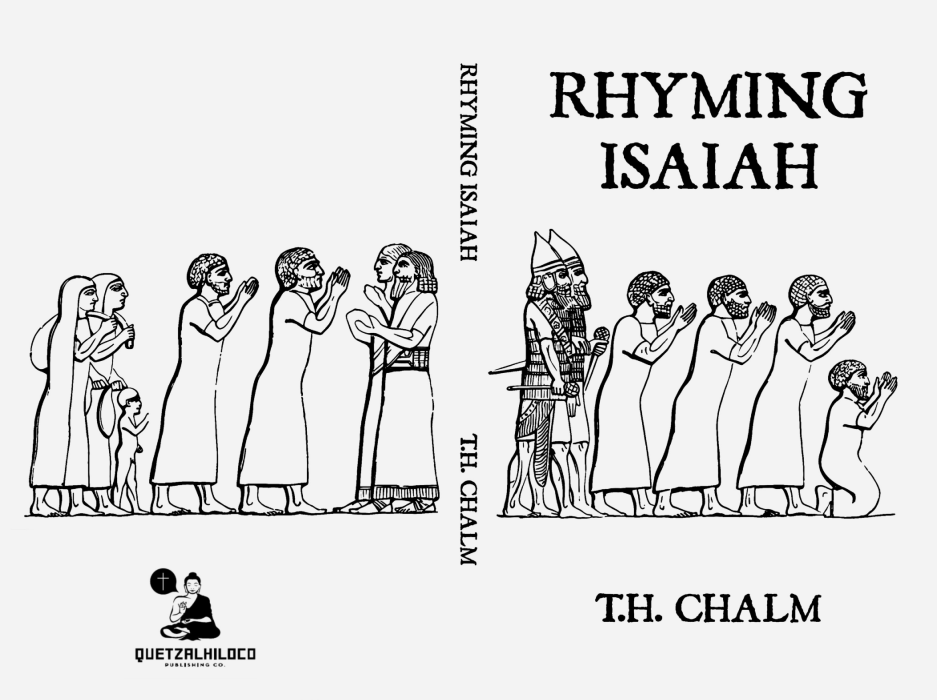
(CC-BY-SA-4.0 Seed fruits of summer asphodel (Asphodelus aestivus), photograph by Zynel Cebeci)

Rhyming Isaiah, Chapter 35

The desert and the parched land will exult,

it will rejoice and bloom, the wilderness;

with fields of asphodel, will flower, it,

with joy and singing how it will rejoice.

Of Lebanon, to it, will given be,

its glory, and to it the majesty

of Sharon and Carmel.  What they will see:

the glory of the Lord will be revealed.

They will, God’s majesty, fully perceive.

The weak hands, strengthen, and the feeble knees,

make firm, and tell those with anxiety,

“Be strong, fear not! Your God comes to save you

here is your God, his vengeance he will shew,

divine, his retribution, thus, it’s true.”

Then, opened, how the blinds’ shut eyes will be,

unstopped, will be the deaf’s ears, how they’ll leap,

the lame will just like deer. Those lacking speech,

with tongues of joy, the way that they will sing.

For in the wilderness, the waters will

break forth, and streams, the desert gulches, fill,

the burning sand it will become a pool,

the thirsty ground where watery springs come from;

a swamp, the jackals haunt, it will become,

to reeds and rushes is the grass transformed.

A highway shall be there and it shall be,

the Holy Way, called, and, not, the unclean,

shall travel on it, but it shall be for

God’s people and, shall go, no traveler

astray, not even fools. No lion, there,

shall be, nor those who’re ravenous, the beasts,

shall come up on it.  There, they’ll, not, found be,

but who will walk there? It is the redeemed.

And, of the LORD, the ransomed shall return,

they’ll shout for joy, to Zion, coming in;

with everlasting joy, their heads are crowned;

it’s joy and gladness what they will obtain,

while suffering and mourning flee away.

Rhyming Isaiah, Chapter 34

Rhyming Isaiah, Chapter 34

Draw near, you nations, so this can be heard;

attention, pay, you peoples, to my words.

The earth hear, let, and all that fills it up,

the world and everything that from it comes.

‘Gainst all the nations, he’s enraged, the LORD,

and furious against their teeming hordes.

He’s doomed them all and them, he’s given o’er

for slaughter.  All the slain have been, not toward,

but cast away, and from each rotting corpse,

the stench of putrid flesh is what’s abhorred.

Be flowing with their blood, the mountains will.

The host of heaven all will rot away,

the heavens will be rolled up like a scroll,

they’ll fade away, all heaven’s hosts arrayed,

just like leaves wither on the vine and fall,

or, dry upon the fig tree, the fruit will.

When, in the heavens, it has drunk its fill,

my sword, lo, it, on Edom, will descend,

in judgment on a people I’ve condemned.

The LORD, a sword, has; it, with blood, is gorged,

with fat, how it has all been covered o’er.

It’s covered with the blood of goats and lambs.

Of rams, their kidneys’, covered with their fat.

A sacrifice in Bozrah, for the LORD,

has, a great slaughter there in Edom’s land.

The oxen, wild, will, too, fall by his sword,

both with young steers and also bulls that gore.

Shall be, with blood, completely soaked, their land,

and how their soil shall be made rich with fat.

A day of vengeance, that, what the LORD has,

it’s vindication’s year for Zion’s cause.

To pitch, all Edom’s streams, they shall be turned,

and, into sulfur, it will be transformed,

her soil. Her land will be like burning pitch.

Not night nor day shall, ever, it, be quenched.

Its smoke, forever, how long it will rise.

From age to age, in waste, how it will lie;

it, never, no one, will pass through again,

But, roosts, the hawk, there, and it has its den,

the hedgehog.  Both of them have their domain

there, both the owl and raven have their nests.

And over it, the LORD, what he will stretch:

a line of chaos and, of emptiness,

the plumb line, making it a land of waste.

There’ll be an absence of nobility

to recognize the king’s authority.

By thistles and by brier’s, totally,

o’er grown with thorns, will be, its palaces,

and they’ll be covered o’er, its fortresses,

by thistles and by briers.  Ostriches

and jackals, they will make it their abode.

The wild cats there will, the hyenas, know,

and satyrs beckon other demon goats,

and Lilith too will find there a repose.

There is a place there for her, rest, to know.

There, it will nest and lay its eggs, the snake.

Its young it hatches and, beneath the shade,

it gathers them.  Each one will have its mate,

the vultures who assemble in that place.

Seek out the LORD’s book and from it read this:

not one of these in that place shall be missed;

not one of them will be, a mate there, sans.

For, of the LORD, his mouth, what it commands,

and by his spirit, he has gathered them.