Rhyming Isaiah, Chapter 23

Rhyming Isaiah, Chapter 23

An oracle concerning Tyre, this.

Wail for your harbor, O ships of Tarshish,
has been destroyed; the time they, of it, learned,
when they had from the Cypress isle returned.
Be still, inhabitants, O, of the coast,
O merchants of Sidon, how they have crossed,
your messengers, have, o’er the deepest sea,
upon the mighty waters of the deep.
The grain of Shihor was your revenue,
the harvest of the Nile, the merchant, you,
the nations’, were. O Sidon, be ashamed,
for, spoken, has, the sea’s, its fortress says,
“I’ve neither labored nor have I giv’n birth.
I’ve neither reared young men nor brought up girls.”
When the report, to Egypt, comes, will, they,
in anguish, be, about, of Tyre, the fate.
Cross over to Tarshish–all of you, wail,
O you inhabitants along the coast!
Is this your ancient city that exults,
whose origin is from the days of old,
whose steps had lead her to roam far afield
so that she could, her colonies, there, found?
Who has made this decision, Tyre, against,
to hand out crowns, what she did in the past,
whose merchants, princes, were, and of the earth,
those honored ones is what her traders were?
The LORD of hosts has planned it–to disgrace
all pride of majesty and to degrade
all those who walk on earth, her honored men.
O ships of Tarshish, cross to your own land,
your harbor is no more. His outstretched hand
is o’er the sea so he can, kingdoms, shake.
It’s their destruction that the LORD ordained,
all Canaan’s strongholds. This is what he says,
You shall exult no more, you who’re oppressed.,
O virgin, daughter, Sidon, rise, o’er, cross–
to Cypress, even there you’ll have no rest.

Look out, the land of the Chaldeans, at!
A people who used to exist, did not.
Assyria, the destined fate for Tyre:
to be consumed by animals who’re wild.
Erected, they, all of their sieging tow’rs,
all of her palaces, they downwards tore,
into a ruin, how they, her, transformed.

Wail for your harbor, O ships of Tarshish,
has been destroyed. From that day Tyre will be,
forgotten, for those long years, seventy,
which is the lifetime of a single king.
When those years, seventy, someday conclude,
just as in the song ‘bout the prostitute,
to Tyre, how it will happen, this is true:

A harp, take, and the city, go, throughout,
you prostitute that everyone forgot!
The sweetest melody, what you should make
so that one day remembered, be, you may.

At the end of years, seventy, the LORD
will visit Tyre, and she’ll return to her
trade, and will prostitute with, of the world,
all of its kingdoms on its face dispersed.
Her merchandise and wages, to the LORD,
will dedicated, be; they won’t be stored,
her profits, neither something they will hoard,
but, merchandise, her, will, abundant food,
supply, and clothing, fine, all of those, for,
who’re living in the presence of the LORD.

Rhyming Isaiah, Chapter 22

Rhyming Isaiah, Chapter 22

This oracle, ‘bout “Vision’s Valley,” is.

Tell me, what with you now has gone amiss,
to be up on the rooftops, for you all,
you city, full of tumult, it exults,
you town? It wasn’t by the sword they fell,
your slain, nor were your dead, in battle, killed.
Your rulers all together, they have fled;
they, captured, were, without a bow, its use.
Those who were found were captured, all of you,
though you, in all directions, had dispersed.
At this I ask you, From me, your eyes, turn
away, and let me weep in misery
and do not, consolation, press on me,
for how my people’s ruin is complete.

For the Lord God of Hosts, what he ordained,
confusion, tumult, tram’pling, of, a day,
in “Vision’s Valley,” how the walls crash down,
and cries for help, they lift up to the mount.
Both chariots, the quiver, Elam bore,
and cavalry, and Kir, his shield is bared.
Your valleys, choice, are filled with chariots,
and you have horsemen posted at the gates.
The heart of Judah’s defense, open, lays.

In the House of the Forest, on that day,
you, to the weapons stored there, turned, your gaze.
In David’s city, what it is you knew,
how many breaches in its walls you saw,
and waters you collected in the pool,
the lower one. Surveyed them all, how you,
the houses of Jerusalem, and some,
to fortify the wall, down, you broke them.
You made a reservoir ‘tween the two walls
so that it filled with water, the old pool.
But to the city’s maker you did not
look to him who had long ago built it.

The Lord, the GOD of Hosts, in that day called
on you to weep and mourn and shave your heads
and put on sackcloth; but there was instead,
joy and festivity, and butchering
of cattle, sheep, was, of them, slaughtering,
they’re eating meat and also drinking wine.
“Let’s eat and drink, tomorrow, for, we die.”
The LORD of Hosts, himself, he has revealed,
in my ears: Surely this iniquity
till you die never will, forgiven, be.
This is the Lord’s word, his, the LORD of Hosts.

The GOD of Hosts, the Lord, says thus: Come, go
and find that steward who’s, as Shebna, known,
the palace master, him, of this apprise:
What do you own here, who gave you the right
to for yourself a tomb cut in the height,
to carve a habitation in the rock
yourself, for? How the LORD’s about to shake
you out just as you would lice from a coat.
He, tightly up, you, is about to roll,
and to a land of vast expanse, he will
throw you just like a ball. There you will die
and there your splendid chariots shall lie,
O you who have disgraced your master’s house!
I from your office will you outwards thrust,
and you will be pulled downwards from your post.

My servant, I’ll send for, that day, upon,
Eliakim, of Hilkiah, the son
and with your robe, I’ll cloth him in that way,
and I will tie your sash around his waist.
With your authority, I’ll him invest,
and he shall be a father to all them,
inhabitants, those of Jerusalem,
and to the house of Judah. I will place,
his shoulder, on, the key to David’s house.
Just like a peg, in place, I will drive him
securely, and, of honor, he, a throne,
to his ancestral house, what he’ll become.
And, his ancestral house, of, the weight, whole,
descendants, offspring, on him, both, they’ll hang,
all of the little dishes, bowls to jugs.
On that day, says the LORD of Hosts, the peg
that was securely drove in place, that way,
will be removed; cut off, how it will fail,
destroyed, that what was hung on it, the load,
for all these words were spoken by the LORD.

Rhyming Isaiah, Chapter 21

Rhyming Isaiah, Chapter 21

An oracle, the desert by the sea,
about. As whirlwinds, through the Negeb, sweep,
it, from the desert, comes. It’s told to me,
a vision, stern; the traitor is betrayed,
he, the destroyer, coming to destroy.
Advance, you, Elam, Media, lay siege;
the sighing she has caused, I’ll make it cease.
Therefore my loins are filled with anguishing,
pain’s pangs have seized me like the pangs of her,
a woman who’s in labor; I can’t hear,
because I am bowed down, I cannot see
because I am dismayed. My mind, it reels,
appalled, me, horror has; what I longed for,
the twilight, into trembling, it’s transformed
for me. The table, that has been prepared,
they spread the rugs, they also drink, they eat.
Rise up, commanders, put oil on the shield!
For this is what the Lord has said to me:
“Go, post a lookout, and let him announce
all that he sees. When he sees them ride out,
paired horsemen and those who, on donkeys, mount,
the camel-riders, diligently let
him listen, very diligently, then.”
The lookout watchman, this, what he proclaimed:
“On the watchtower, Lord, I stay all day,
I’m stationed through the watches of the night.
Look, there they come, paired horsemen, how they ride!”
Then he responded, “Fallen, fallen is,
how, Babylon, and too, the images
of all her gods lie shattered on the ground.”
My people, threshed, you are my winnowed one,
what I have heard, the LORD of Hosts, him, from,
to you announce, the God of Israel.”

Concerning Dumah is this oracle:

From Seir, someone, out to me has cried,
“O Watchman, tell me, what is left of night?
O sentinel, what of the night remains?”
The watchman says, “It’s coming, morning time,
and then it soon will be night once again.
If you’ll inquire, ask; come back later, then.”

The oracle about the desert plain.

That of the desert plain, you’ll live amidst
its scrub, of Dedanites, O caravans.
Bring water to the men who have great thirst,
and meet the fugitive with loaves of bread,
O you inhabitants of Tema’s land.
For they have from the sword, the drawn sword, fled,
from the bent bow, and from the battle’s stress.

“Within a year,” thus, to me, said the LORD,
“the way he counts, a worker who’s been hired,
the years exactly, all that of Kedar,
its glory suddenly, how it will cease;
few bows are left for Kedar’s warriors,”
for Is’rael’s God, the LORD, this, spoken, has.

Frying Pan

IMG_20200517_120435236

Frying Pan

The story of an iron frying pan
that once was owned by a left-handed man.
It every day walked on the garden path
through his backyard, a neighbor’s large, black cat.
His kitchen window, out of it he’d gaze,
to see the cat in its habit’ual ways.
He’d watch him while, his iron pan, he scraped,
to clean it, he with water, would deglaze,
this cooking method that his friend, him, taught.
The sediment of meat, to make a sauce,
sometimes with wine. The after-frying pan,
he’d grasp its handle firm in his right hand
and in his left was a steel spatula,
the pan as black as a tarantula,
a dishtowel that he wrapped, the handle, ‘round,
the sizzle, smoke, it made a sudden sound
that got the cat’s attention right away.
It was the way the pan, he had to scrape,
as hot as it could get o’er gas-lit flame,
at it, but he, because of its square shape,
it wasn’t round, the way that it was made.
The downwards force of ev’ry spatula scratch,
the angle, grinding slightly down, the pan,
an implement, from solid iron, cast.
If ever you have that deficiency,
an iron frying pan, your remedy!
When underneath a magnifying lens,
look to the corners of his frying pan,
the grooves worn by the scraping spatula scratch,
how they were made could only come from that,
a man who grasped the handle in his right,
and his left-handed spatula would grind.
The bottom of the pan, where you should look,
how he would clean it, also how he cooked,
he poured in water and the scraping edge,
that spatula ‘tween pan and meat, a wedge.
The boiling water and the spat’ula scrape,
combined together with what was deglazed,
dark, steaming, meaty soup aimed for the drain,
he’s careful to the countertop avoid,
a careless mess, the man it would annoy.
As he looked up to move back to the stove,
the backyard where his eyes just briefly roved,
a figure, dark, upon the ground was crouched,
against the background, green and gray, pronounced.
The neighbor’s cat was staring straight at him,
ferocity, undoubtedly, it’s with.

Rhyming Isaiah, Chapter 20

Rhyming Isaiah, Chapter 20

The general, the year that he was sent,
King Sargon of Assyria, by him,
to Ashdod, which he stormed, and captured it–
at that time, who the LORD had spoken to,
Isaiah, Son of Amoz: “Go, and loose
the sackcloth from your loins and also take
them off, remove the sandals from your feet,
and he had done so, walking barefoot, nak’d.
The LORD then said, “These years that numbered three,
just as Isaiah, who, my servant, is,
walked naked and barefoot, that time, he has,
to be both portent, also as a sign,
to Egypt, Ethiopia, decry.
Away, so shall Assyria’s, its king,
as captives, all of the Egyptians, lead,
the Ethiopians, to, exiles, be,
the young and old, both naked and barefoot,
their buttocks bared, to Egypt’s disrepute.
Confoundment and dismay, they both will know,
because of Ethiopia, her hope,
because of Egypt, which has been her boast.
In that day, those who live along the coast
will say, ‘See this, what happened, has, to those
in whom we placed our hope and fled for help,
deliverance is what we sought as well,
Assyria, from him, its threat’ning king.
To whom now can we make escape or flee?’”

Rhyming Isaiah, Chapter 19

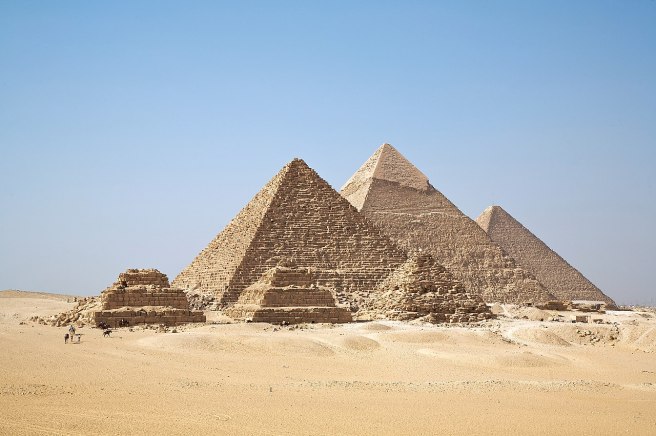
1280px-All_Gizah_Pyramids
(Image Attribution: Ricardo Liberato / CC BY-SA)

Rhyming Isaiah, Chapter 19

It’s Egypt who this oracle’s about.

The LORD comes riding swiftly on a cloud
and he descends to Egypt; their false gods
before him, tremble. Egypt’s courage melts
within her. Egypt, up, against herself,
I will stir Egypt, and how they will fight,
one ‘gainst another, how they’ll be aligned,
a neighbor will have with his neighbor, strife,
one city ‘gainst a city and this too,
a kingdom ‘gainst a kingdom, strife imbued;
within them how their spirit’s emptied out,
is Egypt’s, and their plans I will confound.
They will consult false gods and sorcerers,
with ghosts and spirits who’re familiar,
but the Egyptians, I’ll deliver them
into that of a master, hard, his hand,
and over them, a ruthless king will lord,
this, of the LORD, the Lord of Hosts, his word.

The waters will be drained out from the sea,
and dried, the river Nile, of all her streams;
they’re foul, how all of its canals will be,
they all will rot, her rushes and her reeds.
There will be places, bare, the Nile, beside,
and all that grows along the Nile will dry.
Bullrushes, lotus, by the Nile, were sown,
they’ll be no more, into the wind, they’re blown.
The fishermen as well will mourn and groan,
who in the Nile, cast hooks, all will lament,
all those who in the water spread their nets
will mourn. The workers of the carded flax
will be dejected, and they’ll be downcast,
the linen-weavers, they will be dismayed,
those at the loom. Those working for their wage,
dejected in their hearts, her artisans.

They’re utter fools, the princes of Zoan;
that stupid counsel giv’n, what they relate,
from Pharoah’s counselors, most sage.
To Pharaoh, how is it you dare to say,
“I’m like a wise man from a former age,
a king from long ago, in bygone days”?
Where are your wise men, Pharaoh, to inform
you and make known what has, of Hosts, the LORD,
‘gainst Egypt, planned, and has for them in store.
How Zoan’s princes, fools, they all became.
Deluded, princes, Memphis’s, the same.
All Egypt’s chieftains lead their clans astray.
Poured into them, what has the LORD, conveyed:
a spirit of confusion; and they’ve made
all Egypt miss what she attempts, her ways,
just like a drunkard randomly will stray
about while vomiting. Not head nor tail,
it’s neither palm branch or the bending reed
that can for Egypt do a single thing.

On that day, the Egyptians, how they’ll be
like women, and with fear, they’ve been made weak,
the LORD of Hosts, of him, before his hand
that he has raised against them. And the land
of Judah will, to the Egyptians, be,
a terror; will its very memory,
its name, how it will cause them to dismay,
because against them, what it is he’s laid,
the LORD of Hosts, his plans, those that he made.

Found in that day, five cities, there will be
within the land of Egypt that will speak
the language, same, that’s heard on Canaan’s tongues
and, to the LORD of Hosts, allegiance, swear.
One will be called “The City of the Sun.”

On that day will an altar place be there,
in Egypt’s center, that is to the LORD,
and for the LORD, set up at her frontier,
a sacred pillar. It will be a sign
the LORD of Hosts, to always, him, remind
in Egypt’s land; when to the LORD they cry,
because of their oppressors, he will send
to them, a savior, and he will defend,
and also how he will deliver them.

The LORD, to the Egyptians, he will make
himself known, and Egyptians, the, how they
will know the LORD upon that very day,
and worship with their sacrifice and make
burnt offerings, and they will, to the LORD,
take vows and also will, their vows, perform.
The LORD will strike down Egypt and then bring
them healing; and when they turn back to him,
he’ll, to their prayers, respond, and will heal them.

On that day, how a highway there will be,
Assyria and Egypt, them, between,
and the Assyrian, to Egypt, will
come, the Egyptian to Assyria,
Egyptians and Assyrians as well
will both, together, worship on that day.

With them will Is’rael, as a third, be placed,
with Egypt and Assyria, arrayed,
a blessing there in, of the earth, its midst,
who has, by him, the LORD of Hosts, been blessed,
declaring, “Blessed be Egypt, people, my,
Assyria, too, what my hands designed,
and Is’rael, as my heritage, defined.

Rhyming Isaiah, Chapter 18

Rhyming Isaiah, Chapter 18

There is a land of sailing ships that lies
beyond the rivers in the land of Cush;
ambassadors, it sends, upon the Nile,
papyrus boats, in, they send them across!
Swift messengers, go to a people, tall,
and bronzed, a people, dreaded, far and near,
a nation who is mighty, masterful,
whose lands are, by the rivers, criss-crossed, scoured.

Inhabitants, all you who’re of the world,
and all of you who populate the earth,
look, when a signal on the mount, unfurled!
When, sounded, is, the ram’s horn, you will hear!
For this is what the LORD has said to me:
I, from my dwelling, will look quietly,
when, in the summer’s sun, it shimmers, heat,
when dew at harvest time weighs heavily
When flow’ring ends, before the harvest time,
and blooms will slowly turn to rip’ning grapes,
the branches, he’ll cut off with pruning knives,
the spreading branches, he will hew away.
Out for the mountains’ birds of prey, they’re left,
and for the animals, the earth, that walk.
On them, the birds of prey will craft their nests,
their home for summer, animals will make,
those of the earth, their winter home on them.

At that time gifts will be brought to the LORD
of Hosts, from them, a people, tall and bronzed,
they’re from a people, near and far they’re feared,
a nation that’s aggressive, also strong,
whose land is by the rivers, criss-crossed, scoured.
They bring it to Mount Zion, that the place,
where dwells the LORD of Hosts’, his holy name.