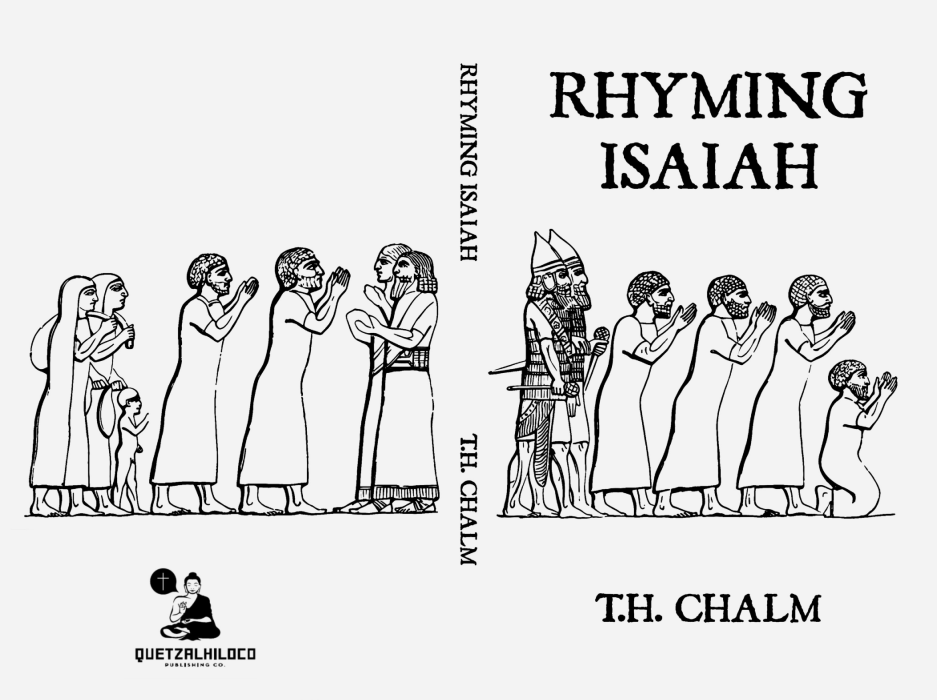
Rhyming Isaiah, Chapter 36
King Hezekiah, in the fourteenth year,
his reign, of it, was when their king appeared,
Assyria’s, named King Sennacherib,
and, those of Judah, how he captured them,
its cities, fortified, he came against.
The king, Assyrian, from Lachish sent
the Rabshakeh, who was, among them, chief
the cupbearers, to Hezekiah, King,
with a great army. To the Fuller’s Field,
the highway, there, upon, was where he stood
nearby its conduit, the upper pool’s.
There, Eliakim, son of Hilkiah,
the master of the palace who he was
with Shebna, secretary of the state,
and Joah, Asaph’s son, the herald, named,
met with the Rabshakeh, there, at that place.
The Rabshakeh then said these words to them,
“Tell Hezekiah: Thus says the great king,
Assyria, the king of: On what do
you base this groundless confidence of yours?
As strategy, do you think your mere words
will pass for that, or power sure for war?
On whom now is it that you will rely
that you, ‘gainst me, rebelled and, me, defied?
On Egypt? Egypt is a splintered reed
that pierces it, the hand of him who leans
upon it. That is Pharaoh, Egypt’s king.
How he is to all who rely on him.
But if you say to me, ‘The LORD, our God,
on him whom we rely,’ that would be odd,
because the places, high, that he removed,
how Hezekiah took the alters too,
and said to Judah and Jerusalem,
‘Before this altar, you shall worship’? Come,
now make a wager with my lord, the king,
Assyrian, if out here you can bring
for them sufficient riders, I will give
two thousand horses to you as I live.
How then, could you repulse a single one
of them, a captain, who’s the least among
my master’s servants, Egypt, when, on them,
how you, for horsemen, chariots, depend.
Moreover, how is it that I have come?
Is it, without the LORD, that I destroy,
come up against this land, so that I may?
The LORD said to me, ‘Up, against this land,
now go and, it, destroy.’” Eliakim,
then, Shebna and Joah, said this to him,
“Please to us, just, in Aramaic, speak
because, your servants understand it, we.
In Judah’s language, to us not at all,
in earshot of the people on the wall
speak to us,” but the Rabshakeh then said,
“Has not my master, me, to speak, here, sent,
these words, to both your master and to you,
and not as well to all those who are doomed,
all of those people sitting on the wall,
with you, to your own excrement consume,
and your own urine, drink, do that you will.”
Then, from his feet, Rabshakeh upwards stood
and called out in a voice that he made loud
in Judah’s language (they knew what he said),
“Now listen to the words of the great king,
Assyria, the king of, I, you, bring.
Do not let Hezekiah, you, deceive,
for powerless to save you, he will be.
Do not let Hezekiah, you, persuade
to, on the LORD, rely; this, what he’ll say:
‘The LORD, deliver us, will certainly,
the city won’t be given to the king,
Assyria, of, to his hand, you’ll see.’
To Hezekiah, give no listening,
for this, says, of Assyria, the king:
Make your peace with me and come out to me
then everyone of you, how you will eat?
From your own vine and from your own fig tree,
and water from your cistern, own, to drink
until I come and, you, away, I’ll take,
a land, to, that is just like your own land,
a land of grain and wine, a land of bread
and vineyards. Do not let him, you, mislead,
when Hezekiah tells you that, ‘The LORD
will save us.’ Of the other nations’ gods,
has any ever saved from the king’s hands,
those of Assyria? Where are the gods
of Hammath, missing too, those of Arpad?
Where are the gods of Sepharvaim? Have they,
Samaria, from clutches, my, yet saved?
All of the countries’ gods, among them, who
have, from my clutches, saved their countries, doomed?
Then how, the LORD, will, save Jerusalem,
from, clutches, my, now-threatening.”
But they were silent and they answered him,
a single word, not, on the king’s command,
which was, “Do not, an answer, give to him.”
Eliakim, then, son of Hilkiah,
who, at the palace, where he was in charge,
and Shebna, who, the secretary, was,
and too, the herald, Asaph’s son, Joah
came, Hezekiah, to, with their clothes torn
and, of the Rabshakeh, told him the words.

 T.H. Chalm