Month: December 2020
Everything will be revealed
Rhyming Bhagavad Gita 2.40
Rhyming Bhagavad Gita 2.40
Working in this state of consciousness
there is no loss or a result, adverse,
and even just the effort of a mite
may save one from a danger that is great.
Rhyming Isaiah, Chapter 38.1-3
Rhyming Isaiah, Chapter 38.1-3
In those days Hezekiah, ill, became
and he was at the point of death, that place.
Isaiah son of Amoz, to him, came,
the prophet, and said to him, “The LORD says:
Your last instructions, to your household, give
for you are dying, you’ll no longer live.
You won’t recover from how you are sick.”
Then to the wall was where he turned his face.
And, to the LORD, how Hezekiah prayed:
“Remember now, O LORD, you, I implore,
how faithfully I’ve walked, with you, before,
with a whole heart, how I consistently,
what’s pleasing to you, did.” And bitterly,
how Hezekiah wept specifically.
Rhyming Isaiah, Chapter 37
Rhyming Isaiah, Chapter 37
King Hezekiah, when he heard their words,
his clothes, like his three officers, he tore,
and sackcloth, with it, covered himself o’er,
and went into the temple of the LORD.
And Eliakim, who it was he sent
(he who, the palace, was in charge of it),
with Shebna, secretary of the state,
and with the senior priests, how straight away,
in sack cloth covered, to the prophet’s place,
the son of Amoz, him, Isaiah, named.
They said to him, “Thus, Hezekiah says,
this day, we designate, one of distress,
and of rebuke and also of disgrace.
We are just like a woman lacking strength,
to bring to birth the child she’s carrying.
It may be that the LORD your God has heard
the Rabshakeh, all that he said, his words,
he whom his master, of Assyria,
the king, has sent him here so he could mock
the living God, and will give a rebuke
to all the words that he, the LORD, has heard,
your God; therefore, please lift for us a prayer
for all the remnant left that’s serving here.”
Of Hezekiah, King, when they all came,
his servants, to Isaiah to relay
his message, this is what Isaiah said:
“Say to your master, ‘Thus, what says the LORD:
The king, Assyrian, all of his words,
afraid, do not be, those of what you heard,
by which his minions sought to blaspheme me.
A spirit in him, I’ll myself insert,
so that he’ll, on a rumor, mere, retreat
to his own land; and, it is by the sword,
I’ll cause him to fall there in his own land.’”
The Rabshakeh returned back to the king,
Assyrian, who decamped from Lachish
to go to Libnah and to, it, besiege,
because, a rumor, to his ears, had reached
about how he advanced, away, from far,
King Tirhakah of Ethiopia:
“To fight against you he set out from here.”
When he had heard it, he sent messengers
to Hezekiah saying: “Thus shall you,
of Judah, Hezekiah, king, speak to:
Him on whom you rely, your God, do not
let him deceive you, promising, by, that,
Jerusalem, into the hand, will not
be given, of the king, Assyrian.
Yourself, you must have heard what they have done,
all of the kings, those ones, Assyrian,
to all lands, utterly destroying them.
Shall you, delivered, be? The nations’ gods,
the ones that predecessors, mine, destroyed,
did they deliver them, Rezeph, Coran,
the Edenites in Telassar, Haran?
Where is the king of Hamath, of Arpad,
the king, he of the Sepharvaim who’s called
the city’s king, of Hena, who is king,
or Ivvah’s king, who’s named here finally?”
The letter, from the messengers, their hands,
how Hezekiah took it straight from them,
and where he went when after, it, he read,
up to the temple and he, out, it, spread
before the LORD. And Hezekiah prayed
to him, the LORD, this, what he said out loud:
“O LORD of hosts, of Is’rael, you are God,
who ‘bove the cherubim you are enthroned.
You are God, you alone, of all the world,
its kingdoms, heaven and the earth, you made.
Incline your ear, O LORD, and hear my plea;
please open them, your eyes, O LORD, and see.
Hear all the words Sennacherib has spoke,
that he has sent, the living God, to mock.
LORD, it is true, those of Assyria,
its kings, all nations, they’ve made desolate
and too, their lands, and have, o’er hurled, their gods
into the fire. They, all of them, destroyed
because they were not gods but, of their hands,
they were the works of men, mere stone and wood.
So now, our God, LORD, save us from his hand
so that all of the kingdoms of the world
may know that you alone, O LORD, are God.”
Isaiah, what the son of Amoz sent,
these words to Hezekiah, saying, then:
“Thus says the LORD, the God of Israel:
Because you’ve prayed to me, against, for help,
Sennacherib, King, of Assyria,
the LORD has spoken this concerning him,
against him, this pronouncement, as his word:
“She both despises you and, you, she scorns–
the virgin daughter, Zion; how her head,
she tosses at you while, retreat, you make,
daughter Jerusalem, behind your back.
“Whom you’ve reviled, as well, whom you have mocked?
Against whom you have upwards raised your voice,
and haughtily, you lifted up your eyes?
The Holy One of Israel, against!
You’ve mocked the LORD, your servants, them, it’s by,
and you said, ‘Many chariots, with my,
up on the mountains heights is where I’ve gone,
to the recesses, far, of Lebanon;
its tallest cedars, I have felled its trees;
I’ve cut them down, its choicest cypresses;
I also came to its remotest height,
its densest forest. Also, wells, dug, I
and drank their waters. I have, up, them, dried,
all Egypt’s streams with the sole of, foot, my.’
“Have you not heard? How all this I prepared
from long ago? From days of old, I planned
what now I bring to pass, that you should make
the cities, fortified, crash into heaps
of ruins, while all their inhabitants,
shorn of their strength, confounded and dismayed,
they have become like plants, those in the field,
and tender like the newly-growing leaves,
just like the grass, the housetops, covering
before it’s grown, the east wind’s withering.
“If you are rising up or sitting down,
if you are coming in or going out,
I know of them, all your activities,
and also how it is you rage ‘gainst me.
Because you’ve raged against me, and my ears,
the place your arrogance has reached, to there,
my hook into your nose, I will insert,
and in your mouth, a bit, what I will put.
I’ll turn you back so that the road you take
on your return, the same on which you came.
“And this will be the portent sign for you:
This year, that, what grows from itself, consume,
and in the second year, what springs from that;
then in the third year sow, reap, vineyards, plant,
and what it is you’ll eat, all of their fruit.
The remnant of the house of Judah that
survives shall once again take, downward, root,
and upward, where it is that they’ll bear fruit;
for from Jerusalem, shall one go out,
a remnant, and a band, from Zion’s Mount,
of those who have survived. The LORD of hosts,
it’s by his zeal, what’s doing all of this.
“Therefore, thus says the LORD concerning him,
the king who is o’er all Assyria:
Into the city he shall not come e’er,
nor will he ever shoot an arrow there,
nor come before it boldly with a shield,
or cast a ramp against it for a siege.
It’s by that way on which he came, the one
on which he shall return; he won’t come in
this city, says the LORD. For I’ll defend
for my own sake, the city, to, it, save,
and also for my servant David’s sake.”
Then how the angel of the LORD set out,
one hundred eighty-five, in thousands count
that number in the camp that he struck down,
of the Assyrians; when morning dawned,
they all were bodies, dead. When he left, then,
Sennacherib, king of Assyria
went home and where he lived, at Nineveh.
One day as he was worshipping his god,
he was inside the temple of Misroch,
his sons, Sharezer and Adrammelech,
together with their swords they, down, him, struck,
and to the land of Ararat, away,
they ran. It was his son who, him, replaced
as the new king, he, Esarhaddon, named.
Rhyming Isaiah, Chapter 37.1
Rhyming Isaiah, Chapter 37.1
King Hezekiah, when he heard their words,
his clothes, like his three officers, he tore,
and sackcloth, with it, covered himself o’er,
and went into the temple of the LORD.
Sennacherib’s Prism
Sennacherib’s Prism
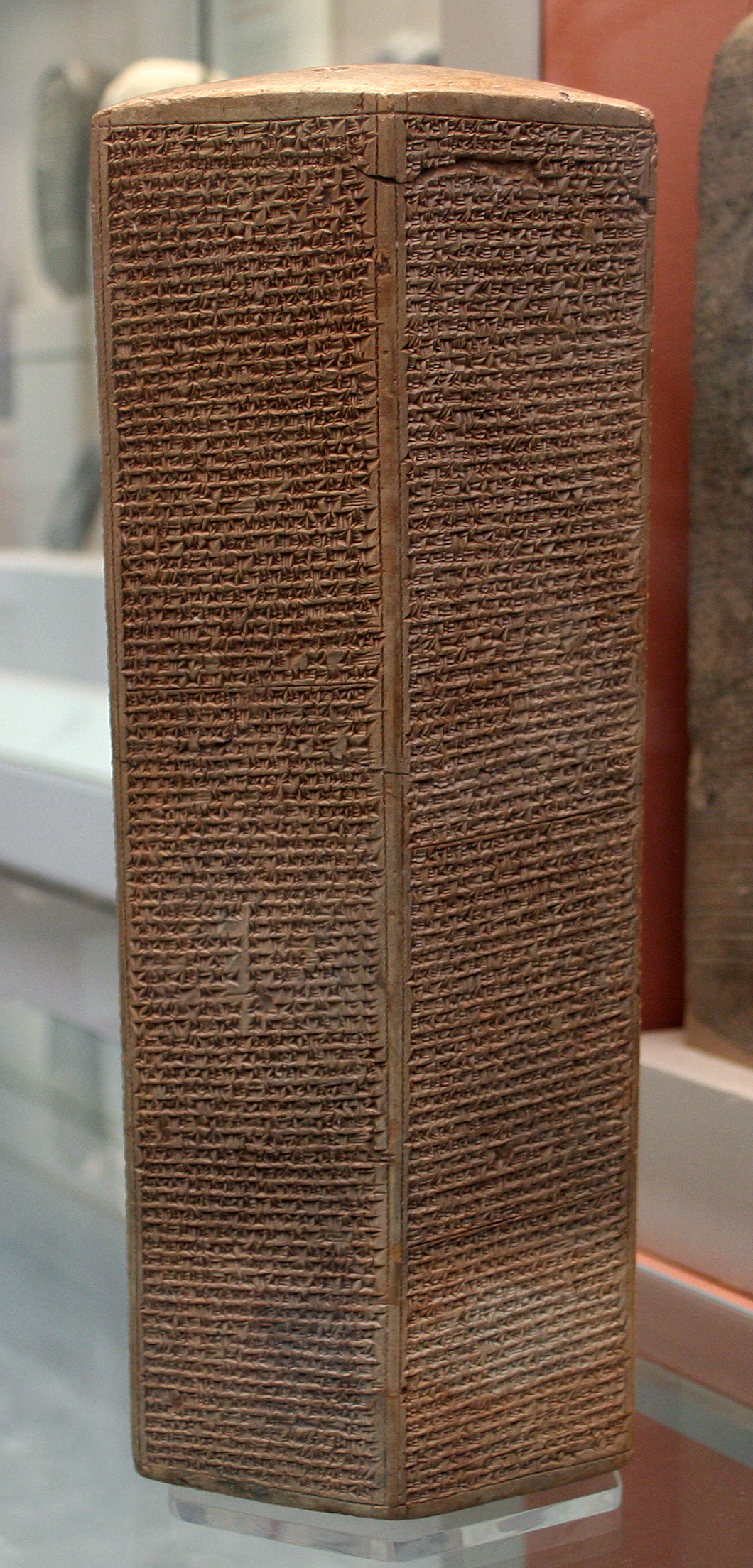
“On Sennacherib’s prism, he says this of Hezekiah: ‘As for the king of Judah, Hezekiah, who had not submitted to my authority, I besieged and captured forty-six of his fortified cities, along with many smaller towns, taken in battle with my battering rams. … I took as plunder 200,150 people, both small and great, male and female, along with a great number of animals including horses, mules, donkeys, camels, oxen, and sheep. As for Hezekiah, I shut him up like a caged bird in his royal city of Jerusalem. I then constructed a series of fortresses around him, and I did not allow anyone to come out of the city gates. His towns which I captured I gave to the kings of Ashod, Ekron, and Gaza.’
“The tribute given by Hezekiah is then mentioned but in this account, nothing is said of Sennacherib capturing the city of Jerusalem.”
 T.H. Chalm