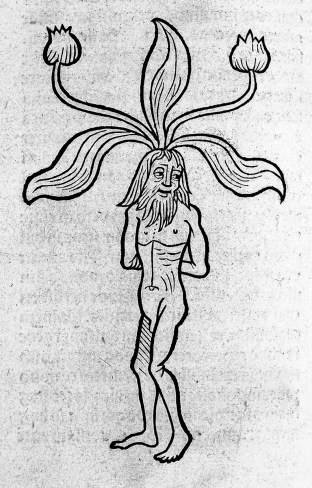
Hortus Sanitatis, plants, male mandrake, 1485, is licensed under CC BY 4.0
LE CLUB DES HASHISCHINS: AN EXPRESSIVE TRANSLITERATION, by T.H. Chalm
INTRODUCTION
“Le Club des Hashischins” originally was the title of an article written by Pierre Jules Théophile Gautier, a French poet, dramatist, novelist, journalist, and art and literary critic who lived from 1811 to 1872. The article was first published in 1846 in Revue des Deux Mondes, subtitled Journal des voyages, a French-language monthly literary and cultural affairs magazine continuously published in Paris since 1829. Literary historians describe the journal’s place in French culture as “anodyne”, which means “not likely to provoke dissent or offense; inoffensive, often deliberately so.”
Gautier’s article presents a first-person narrative account of the supposed experiences of the author (as protagonist) at one of the meetings of Le Club des Hashischins, a club that met regularly in Paris during the 1840s. Its members were intellectuals and artists, including Gautier himself (who was one of the club’s founders), Dr. Jacques-Joseph Moreau, Charles Baudelaire, Victor Hugo, Gérard de Nerval, Eugène Delacroix, and Alexandre Dumas. The club’s name references its central purpose: the creative exploration of shared, hashish-induced experiences in a moderated group setting.
The antagonist of Gautier’s narrative is described as a “mandrake man” who wears a label in his tie that reads “Daucus-Carota, du Pot d’or” (Wild Carrot, of the Gold Pot). From Gautier’s text is this description of Daucus-Carota’s initial appearance:
An enigmatic personage suddenly appeared before me. From whence did he come? I do not know. But his aspect caused me no alarm; his nose was bent like the beak of a bird, his green eyes, which he wiped frequently with a large handkerchief, were encircled with three brown rings, and caught in the knot of a high white starched collar was a visiting card which read: Daucus-Carota, du Pot d’or. The collar choked his thin neck so that the skin of his cheeks overflowed in reddish creases; a black frockcoat, from which hung a chain with a grape cluster, imprisoned his body, which bulged like the breast of a capon. As for his legs, I must avow that they were like mandrake roots, bisected, black, rough, knotty and full of warts, as if torn from the ground with pieces of earth still clinging to the ends. These legs wriggled and twisted with extraordinary activity, and when the small torso which they held stood before me, the strange creature, bursting with sobs, and wiping his eyes first with one arm, then with the other, addressed me in the most pitiful voice: ‘Today is the day that we must die laughing.’ And large, weighty tears rolled down the flanks of his nose. ‘To laugh … To laugh …’ repeated an echoing chorus of discordant and snuffling voices.
As the evening proceeds, Daucus-Carota becomes an absurdly threatening figure, announcing that the club’s members are all prisoners, and time stopped permanently so their sentences were eternal. Under the influence of hashish, in a communal, paranoid fantasy, the members become convinced that his threats are real. While mockingly encouraging attempted escape, he tells them: “‘your corporal punishment will be to observe the motionless hands and return to your seat to start anew, and this until you walk on the bones of your heels.’” The club’s voyant (one of its members who abstains from the green paste “to survey the phantasma and prevent those of us who believed we possessed wings from leaping out the windows”) recognizes that Daucus-Carota has injected disturbing themes into the group’s consciousness, turning the evening “sour”. To alleviate the mood and instantaneously defeat Daucus-Carota’s inane threats, the voyant begins to play the piano, stating: “‘David’s Harp will be replaced by the clavichord of Érard.’” The piano “vexes” Daucus-Carota greatly. At that moment, he is “diminished, flattened, discolored, and shuddered inarticulately; finally [loses] all human form and rolled upon the floor in the shape of a two-rooted salsify” (a plant similar to the wild carrot (daucus carota) as a flowering, edible, root plant with medicinal properties). Instantly, Gautier’s narrator is freed from the spell and its imaginary, eternal prison, and leaves the club’s meeting place in his carriage, returning home safely.
My first goal in writing this poem was to be as faithful as possible to Gautier’s narrative to ensure that I told the same story that he did. My second goal was to create a poem written in a meter that has a specific place in English literature, and through that vehicle, give a new voice to the English-language translations of his article that I relied on in writing my work. I neither read nor write French, and apart from some independent research of the pronunciation and meaning of certain words and names to ensure accuracy of my meter and preserve the meaning of Gautier’s text, I relied completely on these translations in creating my poem.
Psychoactive cannabis sativa (through its concentrate form, hashish) was introduced to Paris and the rest of Europe in the late 18th century after Napoleon’s troops returned from their military campaign in Egypt and Syria. Now in the 21st century, when cannabis is being re-legalized in the United States and throughout the world, we live at a time when this sacred plant medicine is being re-introduced into culture, and the central, playful and mysterious message of Gautier’s Le Club Des Hashischins has continuing and special relevance.
T.H. Chalm
March 3, 2015
 T.H. Chalm