Rhyming Job, Chapter 28: Interlude

Rhyming Job, Chapter 28: Interlude

There is a mine for silver and a place
where gold’s refined. It’s from the earth, they take
the iron, copper smelted from the ore.
An end to darkness, mortal man ensures;
they search out all the farthest recesses
for ore in blackest darkness. Distances,
from human dwellings, there, a shaft, they cleaved,
in places that, untouched by human feet;
they dangle, sway, from others, far away.
The earth, from which all food’s conveyed,
transformed as well below as if by fire;
the rocks, the lapis lazuli perspires.
Its dust, some golden nuggets, will contain.
This hidden path, known by no bird of prey,
No falcon’s eyes has ever witnessed it.
The proud beasts will ne’er on it, their feet, set,
no lion prowls there. People’s hands assault
The mountains’ roots laid bare, the flinty rock
They tunnel through the rock; their eyes see all
its treasures. Ev’ry river’s source would find,
and bring the hidden things out in the light.

But where can wisdom be found here on earth?
What place is understanding dwelling here?
No mortal does, its value, comprehend;
It cannot be found in the living’s land.
The deep says, “It is not in me”; the sea
Says, “It is not with me.” Not with that, e’en,
the finest gold, could it e’er be acquired.
In silver, it cannot be weighed, its price.
It can’t be bought with gold that’s from Ophir,
with lapis lazuli, and onyx, dear.
Not gold nor crystal can, with it, compare,
nor can it be, for jewels of gold, acquired.
Not coral, jasper, worthy to be named;
The rubies’ value, more for wisdom, paid.
The topaz found in Cush cannot compare;
it can’t be bought with gold, that’s pure, most rare.

Where then does wisdom come from? Where it dwells,
does understanding? From their eyes, concealed,
of ev’ry living thing, e’en from the birds,
up in the sky, its place can’t be observed.
Destruction, Death, now both of them will say,
“It’s just a rumor, to our ears, conveyed.”
God understands the method to it all
and he alone knows where it, wisdom, dwells.
For he views all the earth, to all its ends
and he sees everything beneath the heav’ns.
When he established wind, its power, force,
and measured out the waters, the earth, o’er,
when he made a decree for where the rain,
and paths for thunderstorms, he’d designate,
at wisdom, where he looked, and full appraised
it; he confirmed and tested it, and said
unto the human race, “What wisdom is–
Fear of the Lord, and understanding, this:
to evil, shun.” Job, this, with his defense, . . .
Rhyming Job, Chapter 23

Rhyming Job, Chapter 23

“It’s bitter, my complaint, the present tense,
His hand is heavy,” this how Job replied.
“In spite of all my groaning I express.
If only I knew where him, I could find;

“If only I could, to his dwelling, go!
I would, before him, honest, state my case
With heady arguments, my mouth, bestow.
I would find out his answer that I’d face.

“Consider that, what he would say to me.
Would he oppose me now vigorously?
No, he’d no charges ‘gainst me pressing-ly.
The upright, innocence establishing.

“Before him, there, forever from my judge,
The place from where I’d be deliverèd.

“But he’s not there if I go to the east;
If, to the west, my sight, he won’t eclipse.
When in the north he works, him, I won’t see;
When he turns to the south, I catch no glimpse

“of him. But he knows that, the way I take;
When he’s, me, tested, I’ll come forth as gold.
My feet have closely followed all his ways;
To his paths, I have kept, not turned aside.

“I’ve not departed from his lips’ commands;
His words, I’ve treasured, more than daily bread.

“Alone he stands, and who does, him, oppose?
Does what he wants, whate’er that he might please.
He carries out, against me, his decree,
And many plans that he still has in store.
That’s why I’m terrified of him, before;
When I think of all this, I fear him more.
God’s made my heart faint; I am terrified
By the Almighty. Yet, not silencèd,
Though darkness, thick, face-covering applied.”

Rhyming Job, Chapter 19

Rhyming Job, Chapter 19

Then Job replied, “How long, you’ll torment me
and crush me with your words contin’ously?
Ten times now have you brought to me reproach;
how you attack me, shame without, unknown.
If it is true that I, astray have gone,
my error is concern of mine alone.
If you’d exalt yourselves o’er me indeed
and use humiliation against me,
then know that God, the one who has, me, wronged;
the place he’s drug his net: me, all around.

“Though I cry, ‘Violence!’, there’s no reply;
no justice even though, for help, I cry.
He’s blocked my way so that I cannot pass;
in darkness has he shrouded all my paths.
My honor, that, what he has stripped me of,
and from my head, where he, my crown, removed.
He tears me down, I’m gone on ev’ry side;
my hope uprooted as a tree, just like.
His anger burns against me; enemies
of his, he counts me in their company.
His troops advance in force; they build a ramp
for sieging ‘gainst me, ‘round my tent, encamped.

“He, my acquaintances, estranged from me;
from me, alienated family.
They’ve gone so far away, my relatives.
How I’m forgotten by my closest friends,
My female servants, guests, they apprehend,
they count me as a foreigner ‘mongst them.
They, as a stranger, on me cast their eyes.
My servant, summoned — answers, he despised,
e’en though I beg him, words from my own mouth.
Offensive, even to my wife, my breath;
to my own family, loathsome is my life;
the little boys, e’en they, their scorning, rife;
when I appear, it’s me they ridicule.
My closest friends find me detestable;
The ones I love, me, turned themselves against.
I’ve nothing left except my bones and skin;
my teeth, its skin, by that I have escaped.

“Have pity on me, friends, for pity’s sake,
for it, the hand of God has struck me, bruised.
Pursue me now, you, why, like God pursues?
My flesh is less than all that you’d consume?

“Oh, that my words, recorded, on a scroll
were written down, and with an iron tool,
inscribed on lead, to rock engraved fore’er!
I know that my redeemer lives, that there
on earth, where he will stand, until the end.
And after it has been destroyed, my skin,
yet in my flesh I will see God again;
It’s I myself the one who will see him
with my own eyes–I, not another one.
How my heart yearns, my chest, so deep within.

“If you say, ‘Since the root, how, him, we’ll hound,
of all his troubles, is, within him, found.
You should fear for yourselves, of that, the sword;
that weapon will bring punishment for wrath,
what it will bring, and it, you can’t ignore,
that method by which judgment has been passed.”

Rhyming Job 19.23-27

Rhyming Job 19.23-27

“Oh, that my words, recorded, on a scroll
were written down, and with an iron tool,
inscribed on lead, to rock engraved fore’er!
I know that my redeemer lives, that there
on earth, where he will stand, until the end.
And after it has been destroyed, my skin,
yet in my flesh I will see God again;
It’s I myself the one who will see him
with my own eyes–I, not another one.
How my heart yearns, my chest, so deep within.”

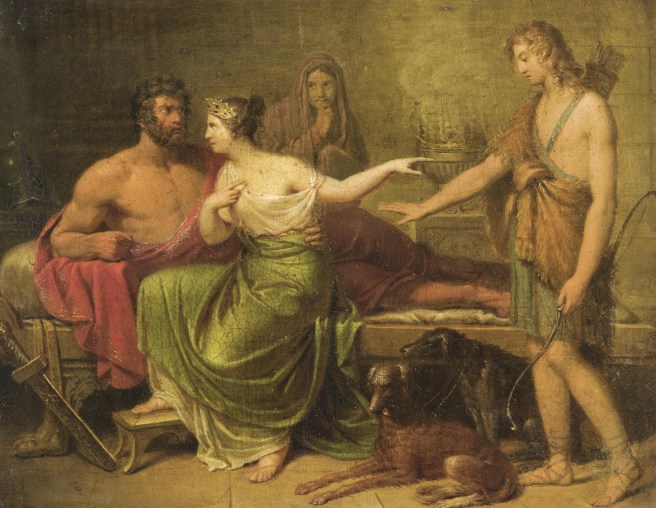
Hippolytus and Aricia

German_school_Hippolytus,_Phaedra_and_Theseus

German school Hippolytus, Phaedra and Theseus

Hippolytus and Aricia

Hippolytus and Aricia’s myth:
His mother dead, he, Theseus’ son,
The daughter of the former king, she is,
whom Theseus usurped to gain the throne,
And banished her to lifelong chastity,
Hippolytus now loves her in his heart.
In secret, it’s forbade by his decree.
For many years did Theseus depart
His kingdom, left Hippolytus at home.
The king’s wife, Phaedra, left there all alone,
And she then falls in love with her stepson.

Rhyming Job, Chapter 14

Rhyming Job, Chapter 14

“Of woman, born, both few and trouble-filled
are mortals’ days. They, upwards, spring for sure:
like flowers that will wither, quickly wilt;
like fleeting shadows that do not endure.
Do you, upon them, careful, fix your eye?
Will you, before you, bring, for judgment, them?
Who brings what’s pure from something unrefined?
No one! A person’s days, determinèd;

“the number of his months, you have decreed
and limits set that he cannot exceed.
So look away from him, please let him be,
till as a hired laborer will he
put in his time. A tree, at least, prevails:
if it’s cut down, again, it upwards sprouts
and its new shoots, not something that will fail.
Its roots grow old, their place is in the ground.
and in the soil is where its stump will die,
yet at the scent of water it will bud
and put forth shoots, a growing plant, it’s like.
A man dies, then, he’s laid low in the mud;
he breathes his last and he is no more, then.
As water in the lake dries up, it’s dry,
and parched, the riverbed becomes, no rain,
so he lies down and no more does he rise;
they won’t awake until the heavens cease,
the people never roused from death’s long sleep.

“If only you would hide me in the grave,
until your anger passes, me, conceal!
If only you, a time for me, you’d make,
a time when you would sure remember me!
If someone dies, will they yet live again?
My many days of service, hard, it’s true.
On my renewal, that, I will depend.
You will call out and I will answer you;
the creature your hands made, you’ll long for him.
For certain, then is when you’ll count my steps
and then no longer keep track of my sin.
Where, sealed up in a bag, all my offense,
a covering o’er all my sin you’ll spread.

“But as a mountain crumbles and erodes
and rock is moved away from out its place,
as water wears away the mighty stones,
the loamy soil, the torrents wash away,
so you destroy the hope a person has.
It’s once for all, how you o’erpower them,
and then, they’re gone; you change their countenance,
away you send them. They won’t know again
if honors, what their children will receive;
if they’re brought low, not something they will see.
All they will feel, the pain their bodies store,
and only for themselves, then, will they mourn.”