Rhyming Job, Chapter 19

Rhyming Job, Chapter 19

Then Job replied, “How long, you’ll torment me
and crush me with your words contin’ously?
Ten times now have you brought to me reproach;
how you attack me, shame without, unknown.
If it is true that I, astray have gone,
my error is concern of mine alone.
If you’d exalt yourselves o’er me indeed
and use humiliation against me,
then know that God, the one who has, me, wronged;
the place he’s drug his net: me, all around.

“Though I cry, ‘Violence!’, there’s no reply;
no justice even though, for help, I cry.
He’s blocked my way so that I cannot pass;
in darkness has he shrouded all my paths.
My honor, that, what he has stripped me of,
and from my head, where he, my crown, removed.
He tears me down, I’m gone on ev’ry side;
my hope uprooted as a tree, just like.
His anger burns against me; enemies
of his, he counts me in their company.
His troops advance in force; they build a ramp
for sieging ‘gainst me, ‘round my tent, encamped.

“He, my acquaintances, estranged from me;
from me, alienated family.
They’ve gone so far away, my relatives.
How I’m forgotten by my closest friends,
My female servants, guests, they apprehend,
they count me as a foreigner ‘mongst them.
They, as a stranger, on me cast their eyes.
My servant, summoned — answers, he despised,
e’en though I beg him, words from my own mouth.
Offensive, even to my wife, my breath;
to my own family, loathsome is my life;
the little boys, e’en they, their scorning, rife;
when I appear, it’s me they ridicule.
My closest friends find me detestable;
The ones I love, me, turned themselves against.
I’ve nothing left except my bones and skin;
my teeth, its skin, by that I have escaped.

“Have pity on me, friends, for pity’s sake,
for it, the hand of God has struck me, bruised.
Pursue me now, you, why, like God pursues?
My flesh is less than all that you’d consume?

“Oh, that my words, recorded, on a scroll
were written down, and with an iron tool,
inscribed on lead, to rock engraved fore’er!
I know that my redeemer lives, that there
on earth, where he will stand, until the end.
And after it has been destroyed, my skin,
yet in my flesh I will see God again;
It’s I myself the one who will see him
with my own eyes–I, not another one.
How my heart yearns, my chest, so deep within.

“If you say, ‘Since the root, how, him, we’ll hound,
of all his troubles, is, within him, found.
You should fear for yourselves, of that, the sword;
that weapon will bring punishment for wrath,
what it will bring, and it, you can’t ignore,
that method by which judgment has been passed.”
Rhyming Job 19.23-27

Rhyming Job 19.23-27

“Oh, that my words, recorded, on a scroll
were written down, and with an iron tool,
inscribed on lead, to rock engraved fore’er!
I know that my redeemer lives, that there
on earth, where he will stand, until the end.
And after it has been destroyed, my skin,
yet in my flesh I will see God again;
It’s I myself the one who will see him
with my own eyes–I, not another one.
How my heart yearns, my chest, so deep within.”

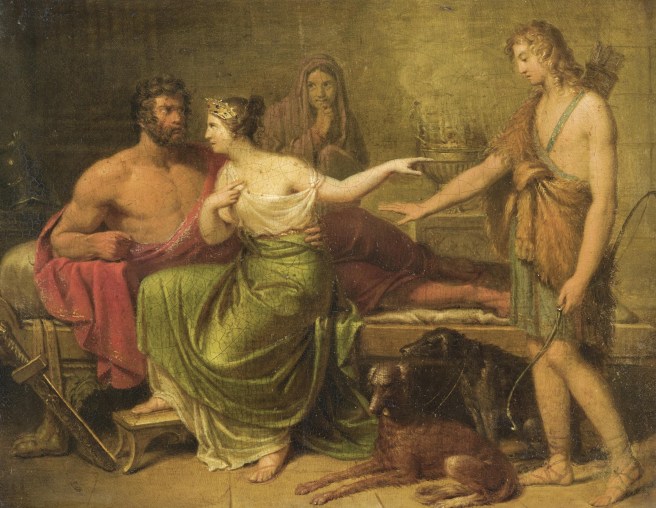
Hippolytus and Aricia

German_school_Hippolytus,_Phaedra_and_Theseus

German school Hippolytus, Phaedra and Theseus

Hippolytus and Aricia

Hippolytus and Aricia’s myth:
His mother dead, he, Theseus’ son,
The daughter of the former king, she is,
whom Theseus usurped to gain the throne,
And banished her to lifelong chastity,
Hippolytus now loves her in his heart.
In secret, it’s forbade by his decree.
For many years did Theseus depart
His kingdom, left Hippolytus at home.
The king’s wife, Phaedra, left there all alone,
And she then falls in love with her stepson.

Rhyming Job, Chapter 14

Rhyming Job, Chapter 14

“Of woman, born, both few and trouble-filled
are mortals’ days. They, upwards, spring for sure:
like flowers that will wither, quickly wilt;
like fleeting shadows that do not endure.
Do you, upon them, careful, fix your eye?
Will you, before you, bring, for judgment, them?
Who brings what’s pure from something unrefined?
No one! A person’s days, determinèd;

“the number of his months, you have decreed
and limits set that he cannot exceed.
So look away from him, please let him be,
till as a hired laborer will he
put in his time. A tree, at least, prevails:
if it’s cut down, again, it upwards sprouts
and its new shoots, not something that will fail.
Its roots grow old, their place is in the ground.
and in the soil is where its stump will die,
yet at the scent of water it will bud
and put forth shoots, a growing plant, it’s like.
A man dies, then, he’s laid low in the mud;
he breathes his last and he is no more, then.
As water in the lake dries up, it’s dry,
and parched, the riverbed becomes, no rain,
so he lies down and no more does he rise;
they won’t awake until the heavens cease,
the people never roused from death’s long sleep.

“If only you would hide me in the grave,
until your anger passes, me, conceal!
If only you, a time for me, you’d make,
a time when you would sure remember me!
If someone dies, will they yet live again?
My many days of service, hard, it’s true.
On my renewal, that, I will depend.
You will call out and I will answer you;
the creature your hands made, you’ll long for him.
For certain, then is when you’ll count my steps
and then no longer keep track of my sin.
Where, sealed up in a bag, all my offense,
a covering o’er all my sin you’ll spread.

“But as a mountain crumbles and erodes
and rock is moved away from out its place,
as water wears away the mighty stones,
the loamy soil, the torrents wash away,
so you destroy the hope a person has.
It’s once for all, how you o’erpower them,
and then, they’re gone; you change their countenance,
away you send them. They won’t know again
if honors, what their children will receive;
if they’re brought low, not something they will see.
All they will feel, the pain their bodies store,
and only for themselves, then, will they mourn.”

Rhyming Job, Chapter 5

Rhyming Job, Chapter 5

“Call if you will, but who will answer you?
Which holy one, your question, you’d convey?
Resentment and vexation kill the fool.
The simple are, by jealously, then slain.

“I’ve seen the fool who’s slowly taking root
but suddenly, his house is cursed and ruined.
His children’s safety, very far away,
with no defender, crushed in court, are they.
His harvest, what the hungry have in store,
and take it even from among the thorns,
the thirsty ones, who, for his wealth, will pant.
Up from the soil, not there, grow hardship’s plants.
Where trouble starts? Not from the ground, arise.
Yet man is born to trouble ‘til he dies,
as surely as the sparks will, upward, fly.

“If I were you, I would appeal to God;
Before him, I would, honest, lay my cause.
The wonders he performs, no fathoming,
his miracles defy all numbering.
It’s for the earth, the rain that he provides;
he’s sending water on the countryside.
The lowly and downcast, he’ll set on high,
and those who mourn, to safety, he will lift.
He thwarts the plans, who make them with their craft,
so that their hands, achieving no success.
He catches wise men in their craftiness,
the wily’s schemes are what he’s swept away,
and darkness comes upon them in the day;
at noon they grope about as in the night.
He saves the needy from the sword inside
their mouth; the clutches of the powerful,
from them, he saves. The poor, with hope, are full,
injustice shuts its mouth. Now then, behold,

“blessed is the one whom God reproves; therefore,
despise not, that, his discipline, the LORD’s.
For he will wound, but he binds up as well;
he shatters, but his hands will also heal.
He will deliver you from troubles, six;
in seven, evil, none, to you will stick.
In famine, he’ll redeem you, his reward.
in war, saves from the power of the sword.
You shall be hidden from the tongue, its lash,
no fear that, it, destruction will, you, smash.
Destruction, famine, at them will you laugh,
no fearing beasts on earth whose teeth will gnash.

“For, with the stones out in the field, in league,
you’ll be with them, out there as well, the beasts
will be at peace with you. What you perceive,
that it, your tent, entirely is at peace,
inspect your fold, possessions won’t, you, leave.
You’ll also know, your offspring multiply,
descendants, yours, like grass on earth grows high.
You’ll come down to your grave in ripe old age,
like sheaves are, in their season, gathered, saved.
Behold, this, we have searched; for it is true.
Now hear this all and know it for your good.”

Rhyming Job, Chapter 4

Rhyming Job, Chapter 4

Then Eliphaz the Temanite replied:

“If someone ventures just a word with you,
would you, impatiently, their words despise?
But who can stop, their speech to you, renewed?
Think how, on your instruction, men rely,

“the hands you’ve strengthened, feeble, too, and weak,
your words supported those with stumbling feet;
you’ve strengthened them, those ones with falt’ring knees.
But now, comes trouble, you, discouraged, feel;
it strikes you, and you are dismayed. Is not
the confidence you have, your fear of God,
your blameless ways, your hope should never stop?

“Consider now: which innocents you know
have ever perished? When, they e’er destroyed,
the upright? I’ve observed, who plow and sow
both evil, trouble, reap them, their reward.
At it, the breath of God, they’re perishing;
destroyed, his anger’s blast, from up above.
The lions’ roaring noises, growling-ly,
the lion’s teeth are now just broken nubs.
For lack of prey, the lion, hungrily,
will die, and scattered, lioness’s cubs.

“A word in secret, what was brought to me,
my ears caught whisper of it. In the night
amid dreams that disquieted, when sleep,
most deep, on people generally will lie.
Both fear and trembling seized me, made them shake:
my bones. A spirit glided past my face,
my body’s hair, all of it, stood on end.
It stopped, but it, I couldn’t understand.
A form stood there before me, ‘fore my eyes,
its voice did not, above a hush, arise:

“‘Can any mortal’s righteousness exceed
God’s righteousness; can that, his purity,
a man who’s strong, be greater than our God’s?
If he, no trust in servants, fallible,
their errors, to his angels, billable,
how much more so will he, to mortal men,
whose houses, made of clay, where they extend,
are their foundations laid down in the dust,
more so than moths, they readily are crushed!
To pieces, broken, dawn until the dusk;

“’Unnoticed, they forever perish, die.
Are not their tent-cords pulled so very high,
so, while they’re lacking wisdom, lose their lives?’”

Rhyming Job, Chapter 3

Rhyming Job, Chapter 3

Then after this, out from his mouth, these poured,
Job’s curses for the day that he was born:

“Let that day perish, that one of my birth,
and too, the night that said: ‘A man’s conceived.’
That day, to darkness, black just like a hearse;
may God above, no thought of it, perceive,

“or cause the light to shine upon that day.
Let gloom claim it again, and darkness, deep;
May clouds drop, settle, blackness o’er it laid,
that day; that night—may darkness, thick, it, seize;

“may it be left from ‘mongst the days we count,
the calendar, nor, in the months, observed.
May it, that night, be barren; may no shouts
of joy be heard on it. May those who curse

“the sea, too, curse that day, whose central aim:
to rouse Leviathan. May they be dark,
its morning stars; fore’er it waits in vain
for daylight and won’t see dawn’s early sparks

“for it did not, the womb’s doors, shut on me;
the present trouble from my eyes, conceal.

“I ask now why, at birth, I didn’t die
and perish, when, the womb, I exited?
Why were there knees that for me, opened wide,
and breasts on which I nursed, was daily fed?

“For now I would be lying down in peace;
I would be sleeping, also, then, at rest
with kings and rulers of the earth, deceased;
their palaces, in ruins, they lie, distressed.

“with princes who had gold, with silver filled,
their houses. Why was I not hid away,
cast to the ground, just as a child, born, still-
an infant who ne’er saw the light of day?

“There where the wicked cease from troubling acts,
and also there, the weary, rest, enjoy.
The captives, slaves, they have their ease, relax;
no longer listen to the driver’s voice.

“The small and great are there, equality,
and there the slaves are from their owners, freed.

“To those in misery, why is light giv’n,
and life to those who’re bitter in their soul,
to those who long for death, it from them, driv’n,
who search for it more than for treasure, gold,

“they’re filled with gladness and their joy, convey,
when they achieve their final goal, the grave?
Why is life given to a man whose way
is hid from him, whom God’s hedged in, constrained?

“For sighing has become my daily food;
my groanings pour out like a water flow.
They’ve come on me, my deepest fears I knew,
the things I dreaded, first-hand, now, I know.

“No quietness of heart, I have no peace;
I have no rest, but only turmoil, feel.”

Rhyming Job, Chapter 2

Rhyming Job, Chapter 2

Upon another day the angels came
before the LORD, as to present themselves,
and Satan, too, himself, he did display.
The LORD said unto Satan, “Now do tell

“where you’ve come from?” Then, Satan made it known:
“From roaming through the earth, I, to and fro,
run back and forth, from place to place, I go.”

The LORD to Satan: “Have, my servant, Job,
considered him, you? None on earth like him;
he’s blameless, upright, God, he fears within,
who’s shunning evil, turns away from sin.
He still maintains it, his integrity,
though you, ‘gainst him, no cause, incited me,
so lacking reason, ruin to him, achieved.”

And in reply said Satan: “Skin for skin!
All that he has, that what a man will give,
for his own life, but now, your hand, stretch out,
his flesh and bones, his body strike, within.
Then to your face, Job’s curses from his mouth.”

The LORD then said to Satan, “Very well,
then, in your hands I place him but I tell
you that his life, that thing, what you must spare.”

So Satan left God’s presence, out from there;
afflicted Job with many painful sores,
from them, his feet, their soles, up to its crown,
his head’s. Some pottery that had been shorn,
he took it, and with it, he scraped them ‘round,
as he, among the ashes, there, remained.

His wife said to him, “Do you still maintain
integrity of yours? Curse God and die!”

“Just like a foolish woman,” his reply,
“is how you’re talking. Shall we just accept
good things from God, but trouble, we reject?”

In all of this, Job kept himself from sin
in what he said. When they heard, Job’s three friends,
were Eliphaz the Temanite, Bildad
the Shuhite, and Zophar the Naamathite,
of all the many troubles that he had,
they set out from their homes to sympathize,
they by agreement, all together met,
to go and comfort him. A distance, yet,
away from him they were, when they saw Job,
and recognized him, there? As one unknown.
To weep aloud, was that, what they began,
they tore their robes, and on their heads, dust, sand,
they sprinklèd. For seven days and nights,
they sat upon the ground with him that time.
Not one of them unto Job said a word,
they saw how great his suffering, him, hurt.

Rhyming Job, Chapter 1

Rhyming Job, Chapter 1

Once in the land of Uz there lived a man
whose name was Job, both upright and blame-free;
God-fearing; evil, from his life, he banned.
His seven sons, and daughters, numbered three.

In thousands, seven, sheep were what he owned.
Three thousand camels, and five hundred each
of donkeys and too, oxen that were yoked.
His servants, numerous, extend his reach.

The man among the people of the East,
the greatest of them all. They held their feasts,

his sons, their birthdays, what they’d celebrate.
Into their homes, their sisters, three, they bade,
to eat and drink with them. It would abate,
the period of feasting, then, Job made,

arrangements for them to be purified,
because, he thought: “My children sinned, perhaps,
and cursed God in their hearts.” How he’d abide,
Job’s custom, regular, that never lapsed.

One day the angels, to present themselves,
they came before the LORD with Satan too.
The LORD said to him, “Where, what you must tell
you’ve come from?” Satan, with his useless truth:

“From roaming through the earth, went to and fro.”
The LORD asked Satan, if these facts, he’d know:

“Have you considered him, my servant, Job?
There’s no one like him underneath the sun;
God-fearing, blameless, upright, evil shunned.”

”Does Job, for nothing,” in reply, “fear God?”
said Satan. “Have you not, a hedge, installed
‘round him, his household, all he does possess?
You’ve blessed the works his hands have made so that
his flocks and herds are through the land, disbursed.
But now stretch out your hand, strike what he has,
then to your face, his curses will, you, tell.”

The LORD then said to Satan, “Very well,
then to your pow’r, all what he has, conveyed,
but, on the man himself, no finger, lay.”

Then Satan left the presence of the LORD.

One day, his sons and daughters feasted, gorged,
their oldest brother’s house, there, drinking wine.
A messenger to Job with this report:
“The oxen plowed, the donkeys grazed nearby,
Sabeans came, attacked, and, to the sword,
they put your servants, livestock that they stole.
To bring this news, I’m the survivor, sole,
from them, how I escaped.” While he yet spoke,

another messenger brought them this news:
“The fire of God fell from the heavens, high,
and burned the sheep and all the servants too;
The only one escaped from there was I.”

Yet while he spoke, another messenger:
“Chaldean raiding parties, three, they formed
and swept down on your camels, stole those herds.
They put your servants, all, unto the sword,
and I alone escaped, this news, to bear!”

While he still spoke, another messenger
appeared and said: “Your sons and daughters too
were feasting, drinking wine, his house was where,
the oldest brother’s, wind, most vi’lent, blew,
most suddenly, swept in that desert air,
and struck the corners, four, the house, construed,
collapsed on them and they’re all dead in there,
and I alone escaped to tell, this, you!”

At this, Job stood and tore his robe, he shaved
his head. To ground he fell, as to display
his worship of his God, and this he said:

“My mother’s womb, from there, I, naked, came,
and from this earth, nude, too, I will depart.
The LORD has given, and he took away;
all praises to his name, the LORD’s, impart.”

In all of this, Job kept himself from sin
by charging God with doing wrong to him.