Rhyming Isaiah, Chapter 21

Rhyming Isaiah, Chapter 21

An oracle, the desert by the sea,
about. As whirlwinds, through the Negeb, sweep,
it, from the desert, comes. It’s told to me,
a vision, stern; the traitor is betrayed,
he, the destroyer, coming to destroy.
Advance, you, Elam, Media, lay siege;
the sighing she has caused, I’ll make it cease.
Therefore my loins are filled with anguishing,
pain’s pangs have seized me like the pangs of her,
a woman who’s in labor; I can’t hear,
because I am bowed down, I cannot see
because I am dismayed. My mind, it reels,
appalled, me, horror has; what I longed for,
the twilight, into trembling, it’s transformed
for me. The table, that has been prepared,
they spread the rugs, they also drink, they eat.
Rise up, commanders, put oil on the shield!
For this is what the Lord has said to me:
“Go, post a lookout, and let him announce
all that he sees. When he sees them ride out,
paired horsemen and those who, on donkeys, mount,
the camel-riders, diligently let
him listen, very diligently, then.”
The lookout watchman, this, what he proclaimed:
“On the watchtower, Lord, I stay all day,
I’m stationed through the watches of the night.
Look, there they come, paired horsemen, how they ride!”
Then he responded, “Fallen, fallen is,
how, Babylon, and too, the images
of all her gods lie shattered on the ground.”
My people, threshed, you are my winnowed one,
what I have heard, the LORD of Hosts, him, from,
to you announce, the God of Israel.”

Concerning Dumah is this oracle:

From Seir, someone, out to me has cried,
“O Watchman, tell me, what is left of night?
O sentinel, what of the night remains?”
The watchman says, “It’s coming, morning time,
and then it soon will be night once again.
If you’ll inquire, ask; come back later, then.”

The oracle about the desert plain.

That of the desert plain, you’ll live amidst
its scrub, of Dedanites, O caravans.
Bring water to the men who have great thirst,
and meet the fugitive with loaves of bread,
O you inhabitants of Tema’s land.
For they have from the sword, the drawn sword, fled,
from the bent bow, and from the battle’s stress.

“Within a year,” thus, to me, said the LORD,
“the way he counts, a worker who’s been hired,
the years exactly, all that of Kedar,
its glory suddenly, how it will cease;
few bows are left for Kedar’s warriors,”
for Is’rael’s God, the LORD, this, spoken, has.

Frying Pan

IMG_20200517_120435236

Frying Pan

The story of an iron frying pan
that once was owned by a left-handed man.
It every day walked on the garden path
through his backyard, a neighbor’s large, black cat.
His kitchen window, out of it he’d gaze,
to see the cat in its habit’ual ways.
He’d watch him while, his iron pan, he scraped,
to clean it, he with water, would deglaze,
this cooking method that his friend, him, taught.
The sediment of meat, to make a sauce,
sometimes with wine. The after-frying pan,
he’d grasp its handle firm in his right hand
and in his left was a steel spatula,
the pan as black as a tarantula,
a dishtowel that he wrapped, the handle, ‘round,
the sizzle, smoke, it made a sudden sound
that got the cat’s attention right away.
It was the way the pan, he had to scrape,
as hot as it could get o’er gas-lit flame,
at it, but he, because of its square shape,
it wasn’t round, the way that it was made.
The downwards force of ev’ry spatula scratch,
the angle, grinding slightly down, the pan,
an implement, from solid iron, cast.
If ever you have that deficiency,
an iron frying pan, your remedy!
When underneath a magnifying lens,
look to the corners of his frying pan,
the grooves worn by the scraping spatula scratch,
how they were made could only come from that,
a man who grasped the handle in his right,
and his left-handed spatula would grind.
The bottom of the pan, where you should look,
how he would clean it, also how he cooked,
he poured in water and the scraping edge,
that spatula ‘tween pan and meat, a wedge.
The boiling water and the spat’ula scrape,
combined together with what was deglazed,
dark, steaming, meaty soup aimed for the drain,
he’s careful to the countertop avoid,
a careless mess, the man it would annoy.
As he looked up to move back to the stove,
the backyard where his eyes just briefly roved,
a figure, dark, upon the ground was crouched,
against the background, green and gray, pronounced.
The neighbor’s cat was staring straight at him,
ferocity, undoubtedly, it’s with.

Rhyming Isaiah, Chapter 20

Rhyming Isaiah, Chapter 20

The general, the year that he was sent,
King Sargon of Assyria, by him,
to Ashdod, which he stormed, and captured it–
at that time, who the LORD had spoken to,
Isaiah, Son of Amoz: “Go, and loose
the sackcloth from your loins and also take
them off, remove the sandals from your feet,
and he had done so, walking barefoot, nak’d.
The LORD then said, “These years that numbered three,
just as Isaiah, who, my servant, is,
walked naked and barefoot, that time, he has,
to be both portent, also as a sign,
to Egypt, Ethiopia, decry.
Away, so shall Assyria’s, its king,
as captives, all of the Egyptians, lead,
the Ethiopians, to, exiles, be,
the young and old, both naked and barefoot,
their buttocks bared, to Egypt’s disrepute.
Confoundment and dismay, they both will know,
because of Ethiopia, her hope,
because of Egypt, which has been her boast.
In that day, those who live along the coast
will say, ‘See this, what happened, has, to those
in whom we placed our hope and fled for help,
deliverance is what we sought as well,
Assyria, from him, its threat’ning king.
To whom now can we make escape or flee?’”

Rhyming Isaiah, Chapter 19

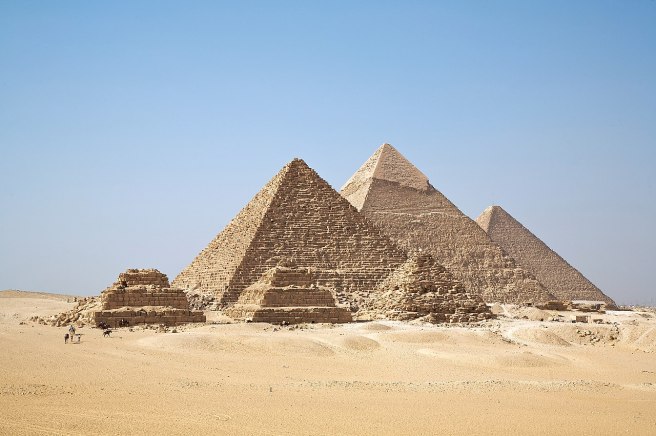
1280px-All_Gizah_Pyramids
(Image Attribution: Ricardo Liberato / CC BY-SA)

Rhyming Isaiah, Chapter 19

It’s Egypt who this oracle’s about.

The LORD comes riding swiftly on a cloud
and he descends to Egypt; their false gods
before him, tremble. Egypt’s courage melts
within her. Egypt, up, against herself,
I will stir Egypt, and how they will fight,
one ‘gainst another, how they’ll be aligned,
a neighbor will have with his neighbor, strife,
one city ‘gainst a city and this too,
a kingdom ‘gainst a kingdom, strife imbued;
within them how their spirit’s emptied out,
is Egypt’s, and their plans I will confound.
They will consult false gods and sorcerers,
with ghosts and spirits who’re familiar,
but the Egyptians, I’ll deliver them
into that of a master, hard, his hand,
and over them, a ruthless king will lord,
this, of the LORD, the Lord of Hosts, his word.

The waters will be drained out from the sea,
and dried, the river Nile, of all her streams;
they’re foul, how all of its canals will be,
they all will rot, her rushes and her reeds.
There will be places, bare, the Nile, beside,
and all that grows along the Nile will dry.
Bullrushes, lotus, by the Nile, were sown,
they’ll be no more, into the wind, they’re blown.
The fishermen as well will mourn and groan,
who in the Nile, cast hooks, all will lament,
all those who in the water spread their nets
will mourn. The workers of the carded flax
will be dejected, and they’ll be downcast,
the linen-weavers, they will be dismayed,
those at the loom. Those working for their wage,
dejected in their hearts, her artisans.

They’re utter fools, the princes of Zoan;
that stupid counsel giv’n, what they relate,
from Pharoah’s counselors, most sage.
To Pharaoh, how is it you dare to say,
“I’m like a wise man from a former age,
a king from long ago, in bygone days”?
Where are your wise men, Pharaoh, to inform
you and make known what has, of Hosts, the LORD,
‘gainst Egypt, planned, and has for them in store.
How Zoan’s princes, fools, they all became.
Deluded, princes, Memphis’s, the same.
All Egypt’s chieftains lead their clans astray.
Poured into them, what has the LORD, conveyed:
a spirit of confusion; and they’ve made
all Egypt miss what she attempts, her ways,
just like a drunkard randomly will stray
about while vomiting. Not head nor tail,
it’s neither palm branch or the bending reed
that can for Egypt do a single thing.

On that day, the Egyptians, how they’ll be
like women, and with fear, they’ve been made weak,
the LORD of Hosts, of him, before his hand
that he has raised against them. And the land
of Judah will, to the Egyptians, be,
a terror; will its very memory,
its name, how it will cause them to dismay,
because against them, what it is he’s laid,
the LORD of Hosts, his plans, those that he made.

Found in that day, five cities, there will be
within the land of Egypt that will speak
the language, same, that’s heard on Canaan’s tongues
and, to the LORD of Hosts, allegiance, swear.
One will be called “The City of the Sun.”

On that day will an altar place be there,
in Egypt’s center, that is to the LORD,
and for the LORD, set up at her frontier,
a sacred pillar. It will be a sign
the LORD of Hosts, to always, him, remind
in Egypt’s land; when to the LORD they cry,
because of their oppressors, he will send
to them, a savior, and he will defend,
and also how he will deliver them.

The LORD, to the Egyptians, he will make
himself known, and Egyptians, the, how they
will know the LORD upon that very day,
and worship with their sacrifice and make
burnt offerings, and they will, to the LORD,
take vows and also will, their vows, perform.
The LORD will strike down Egypt and then bring
them healing; and when they turn back to him,
he’ll, to their prayers, respond, and will heal them.

On that day, how a highway there will be,
Assyria and Egypt, them, between,
and the Assyrian, to Egypt, will
come, the Egyptian to Assyria,
Egyptians and Assyrians as well
will both, together, worship on that day.

With them will Is’rael, as a third, be placed,
with Egypt and Assyria, arrayed,
a blessing there in, of the earth, its midst,
who has, by him, the LORD of Hosts, been blessed,
declaring, “Blessed be Egypt, people, my,
Assyria, too, what my hands designed,
and Is’rael, as my heritage, defined.

Rhyming Isaiah, Chapter 18

Rhyming Isaiah, Chapter 18

There is a land of sailing ships that lies
beyond the rivers in the land of Cush;
ambassadors, it sends, upon the Nile,
papyrus boats, in, they send them across!
Swift messengers, go to a people, tall,
and bronzed, a people, dreaded, far and near,
a nation who is mighty, masterful,
whose lands are, by the rivers, criss-crossed, scoured.

Inhabitants, all you who’re of the world,
and all of you who populate the earth,
look, when a signal on the mount, unfurled!
When, sounded, is, the ram’s horn, you will hear!
For this is what the LORD has said to me:
I, from my dwelling, will look quietly,
when, in the summer’s sun, it shimmers, heat,
when dew at harvest time weighs heavily
When flow’ring ends, before the harvest time,
and blooms will slowly turn to rip’ning grapes,
the branches, he’ll cut off with pruning knives,
the spreading branches, he will hew away.
Out for the mountains’ birds of prey, they’re left,
and for the animals, the earth, that walk.
On them, the birds of prey will craft their nests,
their home for summer, animals will make,
those of the earth, their winter home on them.

At that time gifts will be brought to the LORD
of Hosts, from them, a people, tall and bronzed,
they’re from a people, near and far they’re feared,
a nation that’s aggressive, also strong,
whose land is by the rivers, criss-crossed, scoured.
They bring it to Mount Zion, that the place,
where dwells the LORD of Hosts’, his holy name.

Rhyming Isaiah, Chapter 17

Rhyming Isaiah, Chapter 17

This oracle, about Damascus, is.

“To be a city will Damascus cease,
and what she will become: a heap of ruins.
Forever will, deserted, be, her towns;
for flocks, they will be places, which lie down
and rest, there’s no one to disturb them there.
From Ephraim will its fortress disappear,
from sovereignty, away, Damascus veers;
and then how Aram’s remnant will be like,
the glory of the children, Israelite,”
this is the word of him the LORD of Hosts.

“That day will Jacob’s glory be brought low,
and lean, how, of his flesh, its fat will grow.
As when a reaper gathers standing grain
by armfuls, ears, what they are harvesting,
or as one gleans the ears in Rephaim’s vale,
or as when beaten is the olive tree
and only gleanings are left to retrieve,
they’re on the topmost branch, two berries, three,
upon its fruitful boughs, just five, or four,”
the LORD, the God of Is’rael, this, his word.

That day, a man will, to his Maker, look,
his eyes, to Israel’s Holy One, will train.
He will no longer, to his handiwork,
look to his altars, or what they have made,
such worship objects, by his fingers, own,
the incense altars and the sacred poles.

That day, how their strong cities will be like
the places of the Hivites, Amorites
that they deserted at Is’rael’s advance,
those they abandoned, they shall be laid waste.

Since you, of your deliverance, forgot,
the God who saved you, also, you did not
remember him, your stronghold place, your Rock.
Therefore, though you will, pleasure gardens, plant,
out for a foreign god, your cuttings, set,
the day you plant them, you get them to grow,
they’re flow’ring in the morning when you sow,
yet quickly, on, that harvest fades away,
of grief, pain that’s incurable, the day.

Disaster! It’s the thunder of vast hordes,
a thunder like the thunder of the sea!
The nations, how, like mighty floods, they roar,
but he rebukes them, far away they flee,
on mountains, chased like chaff, the wind, before,
and whirling dust that blows before the storm.
In evening time, it’s terror that they spread!
But by the morning time they’ve disappeared.
Of those who, us, despoil, this is their fate,
of those who plunder us, this is their lot.

Rhyming Isaiah, Chapter 16

Rhyming Isaiah, Chapter 16

The ruler of the land, to him, send lambs,
from Sela, of the desert, by its way,
to daughter Zion’s mount. Like those outcast,
birds, flutt’ring, scattered nestlings, at the place
are Moab’s women, at the Arnon’s fords.
“Now give us counsel, justice, us, provide;
make it like night, at the noon’s height, your shade;
the outcasts are the ones whom you should hide,
and also don’t, the fugitives, betray;
let Moab’s exiles find with you a place;
to them, be refuge, in destruction’s face.”

Once the oppression’s past, the ruin, complete,
when, from the land, gone, the aggressor’s heel,
then how a throne, established, it will be,
in David’s tent, and on it there will sit
a ruler, judge, who, justice, always seeks,
and doing what is right, at that, he’s swift.

We’ve heard how great is Moab’s haughtiness–
how proud he is! His pride, his arrogance,
and too his insolence; his boasts are false.
Therefore let Moab wail for Moab’s sake.
Kir-Hareseth, for all its raisin cakes,
you mourn, with grief, your heart will, stricken, be.
For Heshbon’s vineyards all are withering,
the grapes that once, on Sibmah’s vines, had hung,
whose clusters made the lords of nations drunk,
those vines, as far as Jazer, where they reached,
out to the desert, they went windingly,
its spreading branches, over, crossed, the sea.
Therefore with Jazer’s weeping, I will weep,
for Sibmah’s vines; I drench you with my tears,
O Heshbon and Elealeh; for ceased,
the shout, the harvest of your fruit, has, o’er,
and too, the harvest of your grain, no more.

Away, both joy and gladness, taken are,
from the field, fruitful; in the vineyard’s place,
no songs are sung and no more shouts are raised;
no treader in the presses, wine, treads out,
and also hushed is it, the vintage-shout!
Therefore for Moab, harp-like, throbs my heart
and too my very soul for Kir-heres.

Though all, to worship, come, the Moabites,
and, they, themselves, will weary, at their shrines,
they to their sanctuaries flock to pray,
despite that, nothing, them, will it avail.

These words the LORD spoke of the former days,
concerning Moab, but the LORD now says,

“Just as a worker, hour’ly, them, would count,
in three years, Moab’s glory it derives
from its great populace, it will be brought
into contempt and those who still survive
will be both few and feeble in their lives.”

Rhyming Isaiah, Chapter 15

Rhyming Isaiah, Chapter 15

A proclamation that, Moab, regards:

Because, just in a night, laid waste is Ar,
undone is Moab; too, because of Kir,
how it’s laid waste, so Moab is undone.
Up to the temples, so that, weep, they can,
Dibon’s, her people; over both of them,
it’s Nebo and Medeba, Moab wails.
Each head is bald and ev’ry beard is shaved;
out in the streets it’s sackcloth that they wear,
they cry from rooftops, in the public squares,
wails, everyone, as well, they melt in tears.
Both Hesbon and Elealeh cry out,
their voices are heard as far as Jahaz.
Alarmed are Moab’s warriors, most stout;
and all their courage, quick to melt away.
My heart cries out for Moab in distress;
to Zoar, where they flee, his fugitives.
They go out to Eglath-Shelishiyah.
On the ascent to Luhith, how they go
up weeping; there, on Horonaim, the road,
destruction, of, a cry is what they raise;
the waters of Nimrim became a waste;
the grass is withered and the new growth fails,
and not a single green thing is sustained.
Therefore, all the abundance that they gained,
what they laid up, where it’s carried away,
o’er Wadi Arabim. For what has gone,
a cry to Moab’s frontiers, all around;
their wailing reaches, Eglaim, Beer-elim,
from both. With blood, the waters of Dibon
are full; yet even worse, I’ll bring upon
Dibon–for the survivors of Moab,
a lion, for the remnant in the land.