Rhyming Job, Chapter 42.1-6

Rhyming Job, Chapter 42.1-6

Then Job replied, this manner, to the LORD:

“I know that you can do all things; of yours,
no purpose, anyone could ever thwart.
You asked, ‘Who is this that, my plans, obscures,
who’s lacking knowledge?’ How, of things, I spoke
for sure I didn’t understand, conceive,
some things too wonderful for me to know.

“What you said, ‘Listen now, and I will speak;
I’ll question you, and you shall answer me.’
My ears heard of you for my life, entire,
but now I’ve witnessed you with my own eyes.
Therefore myself, now what I full despise,
in dust and ashes, I’ll repent, chastised.”

Rhyming Job, Chapter 38

Rhyming Job, Chapter 38

Then he, the LORD, spoke to Job from the storm.

He said: “Who is this that, my plans, obscures
with words that have no knowledge? Brace yourself
just like a man; I’ve come to question you,
and to my questions, answer me, you shall.

“Where were you when I laid it, that, the earth’s,
foundation. Tell me, if you understand.
Who, its dimensions, marked? You know its girth!
A line to measure, ‘cross it, who expands?
Upon what were its deepest footings sank,
or who, the person, laid its cornerstone —
while all the morning stars, together, sang
and all the angels shouted out for joy?

“Who shut the sea up in its doors so quick,
when from the womb, it burst forth, when I made
the clouds its garment and in darkness, thick,
I wrapped it in; I, limits, for it placed,
its doors and bars are what I firmly fixed,
when I said, ‘Here is where, your proudest waves
the place they’ll halt, this is their further-est’?

“Have you e’er, orders, to the morning, gave,
or shown the dawn the place where it will go,
that it might, by its edges, earth, up, take,
the wicked, clean, from out of it, o’erthrown?
Like clay beneath a seal, the earth takes shape,
its features stand out like those of a garb.
The wicked are denied their light, upraised,
their arm that is, it’s broken off, a nub.

“Have you into the sea’s springs, journeyed there
or walked ‘mongst the recesses of the deep?
Have they been shown to you, the gates of death?
The deepest darkness, its gates, have you seen?
Its vast expanses, comprehend the earth’s,
have you? If you know all of this, tell me.

“What is the way to the abode of light?
And where the darkness presently resides?
Can you take them, their place, specifically?
Do you know paths that to their dwellings, lead?
For you, already born, you know for sure!
For certain you have lived so many years!

“The snow’s storehouses, have you entered them,
or seen storehouses where’s kept all the hail,
that I reserve for times of trouble, and
for days of war and battle? What, the way,
unto that place where, scattered o’er the earth,
the east winds are? Who makes the crevices,
for rain, its torrents, thunderstorm, its paths
to water a land where nobody lives,
a desert that is uninhabited,
a des’late wasteland, satisfy, it would
and sprout with grass? Does rain, distributed,
a father, have? Who fathers drops of dew?
From whose womb comes the ice? Birth, to the frost,
who gives that, from the heavens, hard as stone,
when they, the waters, stillness, what is caused,
when, it, the surface of the deep is froze?

“Can you, up in the Pleiades, bind chains?
Can you, it, loosen, star-Orion’s belt?
The constellations, in their seasons, can
you bring them forth, or with its cubs, compel
the Bear? Do you know all its laws for sure,
those of the heav’ns? Can you for me, assert,
dominion, God’s, establish, o’er the earth?

”Your voice into the clouds, can it, you raise,
with water’s flood, yourself, then, cover o’er?
Do you send bolts of lightning on their way?
Do they report to you, ‘Hey, here we are!’?
Who gives the ibis wisdom, or who gives
the rooster understanding? Count the clouds,
who has the wisdom such a task requires?
Who pours the water jars in heaven out
when dust becomes hard, dry upon the earth,
and they will stick, together, clods of dirt?

“Do you hunt prey for her, the lioness,
the hunger of the lions, satisfy,
they crouch in thickets, when they’re in their dens,
in wait, they lie? Who, food, this bird, provides,
the raven, black, when its young cry to God
and wander all about for lack of food?

Rhyming Job, Chapter 31

Rhyming Job, Chapter 31

“With them, my eyes, I made a covenant,
at women, young, I’d not look lustfully.
From God above, our lot, but what is that,
our heritage from the Almighty, high?
Is it not ruin for those, the wicked men,
disaster for those who do wrong, at fault?
Does he not see my ways, each step of mine?

“If I, with falsehood, how it is I’ve walked,
or hurried, has my foot, after deceit —
In honest scales, may God record my mass,
and that I am as blameless, still, he’ll see —
if my steps have turned off from it, the path,
if my heart has been led by them, my eyes,
or if my hands have been, themselves, defiled,
then may let others eat what I have sown,
my crops uprooted from the place they’ve known.

“If my heart has, by woman, been enticed,
or if my neighbor’s door, at it, I’ve lurked,
then may my wife, another man’s grain, grind,
then any other man may sleep with her.
For that would have been wicked, to be judged
a sin. Like one that burns, it is a fire,
unto Destruction; that, my harvest, would,

“uprooted, have. If justice, I’ve denied,
to servant, female, male, irrelevant,
when they, against me, had their grievances,
when God confronts me, what will I do then?
Called to account, what is my consequence?
Did not he who made me as well make them
inside the womb? Did not the same one form
us both within our mothers? If contempt,
for their desires is what I have, the poor’s,
or let the widow’s eyes, with weariness,
grow, if unto myself, I’ve kept my bread,
if I don’t share it with the fatherless —
but from my youth, I reared them as he would,
a father, and the widow, from my birth,
I guided her — if e’er seen one, I had,
for lack of clothing, perishing from earth,
those needy ones who, garments, what they lack
and their hearts did, no blessing for me, have
for warming them with fleece, from my sheep, cut,
if ‘gainst the fatherless, upraised a hand,
e’en knowing of my influence in court,
then let my arm fall from its shoulder joint,
let it be broken off right at that point.
Destruction, dreaded, that, my God would bring,
for fear, his splendor, I’d ne’er do such things.

“If I’ve put all my trust in gold or tell
to purest gold, ‘You’re my security,’
if I’ve rejoiced o’er my exceeding wealth,
the fortune that my hands have gained for me,
if I regarded, in its rad’iancy,
the sun’s, its splendor, how the moon traversed,
so that my heart, enticed, in secrecy,
and my hand offered them an homage kiss,
then these would be my sins that should be judged
for I’d have been unfaithful, God above.

“If I, at his, my enemy’s, rejoiced,
misfortune, or the trouble, over that
which came to him — my mouth, I’ve not allowed
to sin that way, invoking curses ‘gainst
their life — ‘Who’s not been filled before with meat’
(if those ‘mongst household, mine, ne’er said) ‘from Job?’ —
but strangers, none, e’er sleeping in the street,
for, to the traveler, it’s wide and ope’d,
my door — if I, as people do, enshroud
my sin by hiding guilt deep in my heart
because I was so fearful of the crowd,
I’d dread the clans’ contempt, their low regard,
that I kept silent, go outside, I’d not —

(“Oh, that someone, my pleas, would hear! I sign
now my defense — let the Almighty God,
now answer me; let him, now, me, indict,
in writing, my accuser, put it down.
I’d surely wear it on my shoulder, I
would put it on my head just like a crown.
I’d give account of ev’ry step of mine
to him; a presentation that comports
with how you’d give a ruler a report.) —

“if my land cries out ‘gainst me and they’re wet,
its furrows, all of them, with weeping tears,
if I’ve devoured its yield, no payment spent,
if I broke tenants’ spirits, made them fear,
not wheat but briars, from the soil, would raise,
and stinkweed in my field, in barley’s place.”

Job’s words here, ended; none more, he conveyed.
Rhyming Job, Chapter 28: Interlude

Rhyming Job, Chapter 28: Interlude

There is a mine for silver and a place
where gold’s refined. It’s from the earth, they take
the iron, copper smelted from the ore.
An end to darkness, mortal man ensures;
they search out all the farthest recesses
for ore in blackest darkness. Distances,
from human dwellings, there, a shaft, they cleaved,
in places that, untouched by human feet;
they dangle, sway, from others, far away.
The earth, from which all food’s conveyed,
transformed as well below as if by fire;
the rocks, the lapis lazuli perspires.
Its dust, some golden nuggets, will contain.
This hidden path, known by no bird of prey,
No falcon’s eyes has ever witnessed it.
The proud beasts will ne’er on it, their feet, set,
no lion prowls there. People’s hands assault
The mountains’ roots laid bare, the flinty rock
They tunnel through the rock; their eyes see all
its treasures. Ev’ry river’s source would find,
and bring the hidden things out in the light.

But where can wisdom be found here on earth?
What place is understanding dwelling here?
No mortal does, its value, comprehend;
It cannot be found in the living’s land.
The deep says, “It is not in me”; the sea
Says, “It is not with me.” Not with that, e’en,
the finest gold, could it e’er be acquired.
In silver, it cannot be weighed, its price.
It can’t be bought with gold that’s from Ophir,
with lapis lazuli, and onyx, dear.
Not gold nor crystal can, with it, compare,
nor can it be, for jewels of gold, acquired.
Not coral, jasper, worthy to be named;
The rubies’ value, more for wisdom, paid.
The topaz found in Cush cannot compare;
it can’t be bought with gold, that’s pure, most rare.

Where then does wisdom come from? Where it dwells,
does understanding? From their eyes, concealed,
of ev’ry living thing, e’en from the birds,
up in the sky, its place can’t be observed.
Destruction, Death, now both of them will say,
“It’s just a rumor, to our ears, conveyed.”
God understands the method to it all
and he alone knows where it, wisdom, dwells.
For he views all the earth, to all its ends
and he sees everything beneath the heav’ns.
When he established wind, its power, force,
and measured out the waters, the earth, o’er,
when he made a decree for where the rain,
and paths for thunderstorms, he’d designate,
at wisdom, where he looked, and full appraised
it; he confirmed and tested it, and said
unto the human race, “What wisdom is–
Fear of the Lord, and understanding, this:
to evil, shun.” Job, this, with his defense, . . .

Rhyming Job, Chapter 23

Rhyming Job, Chapter 23

“It’s bitter, my complaint, the present tense,
His hand is heavy,” this how Job replied.
“In spite of all my groaning I express.
If only I knew where him, I could find;

“If only I could, to his dwelling, go!
I would, before him, honest, state my case
With heady arguments, my mouth, bestow.
I would find out his answer that I’d face.

“Consider that, what he would say to me.
Would he oppose me now vigorously?
No, he’d no charges ‘gainst me pressing-ly.
The upright, innocence establishing.

“Before him, there, forever from my judge,
The place from where I’d be deliverèd.

“But he’s not there if I go to the east;
If, to the west, my sight, he won’t eclipse.
When in the north he works, him, I won’t see;
When he turns to the south, I catch no glimpse

“of him. But he knows that, the way I take;
When he’s, me, tested, I’ll come forth as gold.
My feet have closely followed all his ways;
To his paths, I have kept, not turned aside.

“I’ve not departed from his lips’ commands;
His words, I’ve treasured, more than daily bread.

“Alone he stands, and who does, him, oppose?
Does what he wants, whate’er that he might please.
He carries out, against me, his decree,
And many plans that he still has in store.
That’s why I’m terrified of him, before;
When I think of all this, I fear him more.
God’s made my heart faint; I am terrified
By the Almighty. Yet, not silencèd,
Though darkness, thick, face-covering applied.”

Rhyming Job, Chapter 19

Rhyming Job, Chapter 19

Then Job replied, “How long, you’ll torment me
and crush me with your words contin’ously?
Ten times now have you brought to me reproach;
how you attack me, shame without, unknown.
If it is true that I, astray have gone,
my error is concern of mine alone.
If you’d exalt yourselves o’er me indeed
and use humiliation against me,
then know that God, the one who has, me, wronged;
the place he’s drug his net: me, all around.

“Though I cry, ‘Violence!’, there’s no reply;
no justice even though, for help, I cry.
He’s blocked my way so that I cannot pass;
in darkness has he shrouded all my paths.
My honor, that, what he has stripped me of,
and from my head, where he, my crown, removed.
He tears me down, I’m gone on ev’ry side;
my hope uprooted as a tree, just like.
His anger burns against me; enemies
of his, he counts me in their company.
His troops advance in force; they build a ramp
for sieging ‘gainst me, ‘round my tent, encamped.

“He, my acquaintances, estranged from me;
from me, alienated family.
They’ve gone so far away, my relatives.
How I’m forgotten by my closest friends,
My female servants, guests, they apprehend,
they count me as a foreigner ‘mongst them.
They, as a stranger, on me cast their eyes.
My servant, summoned — answers, he despised,
e’en though I beg him, words from my own mouth.
Offensive, even to my wife, my breath;
to my own family, loathsome is my life;
the little boys, e’en they, their scorning, rife;
when I appear, it’s me they ridicule.
My closest friends find me detestable;
The ones I love, me, turned themselves against.
I’ve nothing left except my bones and skin;
my teeth, its skin, by that I have escaped.

“Have pity on me, friends, for pity’s sake,
for it, the hand of God has struck me, bruised.
Pursue me now, you, why, like God pursues?
My flesh is less than all that you’d consume?

“Oh, that my words, recorded, on a scroll
were written down, and with an iron tool,
inscribed on lead, to rock engraved fore’er!
I know that my redeemer lives, that there
on earth, where he will stand, until the end.
And after it has been destroyed, my skin,
yet in my flesh I will see God again;
It’s I myself the one who will see him
with my own eyes–I, not another one.
How my heart yearns, my chest, so deep within.

“If you say, ‘Since the root, how, him, we’ll hound,
of all his troubles, is, within him, found.
You should fear for yourselves, of that, the sword;
that weapon will bring punishment for wrath,
what it will bring, and it, you can’t ignore,
that method by which judgment has been passed.”

Rhyming Job 19.23-27

Rhyming Job 19.23-27

“Oh, that my words, recorded, on a scroll
were written down, and with an iron tool,
inscribed on lead, to rock engraved fore’er!
I know that my redeemer lives, that there
on earth, where he will stand, until the end.
And after it has been destroyed, my skin,
yet in my flesh I will see God again;
It’s I myself the one who will see him
with my own eyes–I, not another one.
How my heart yearns, my chest, so deep within.”

Hippolytus and Aricia

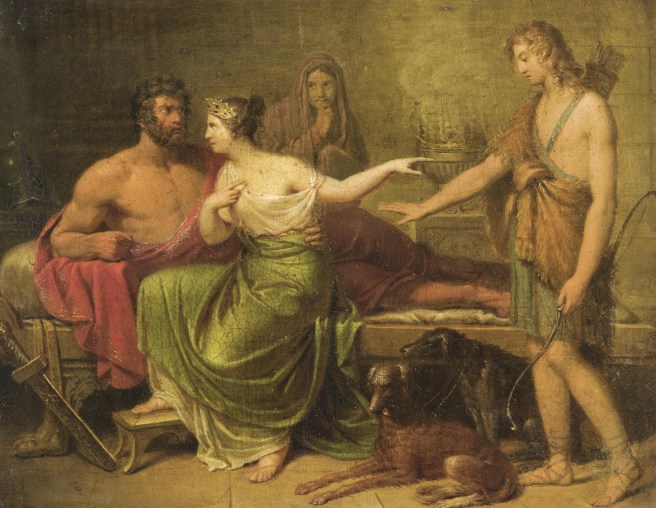
German_school_Hippolytus,_Phaedra_and_Theseus

German school Hippolytus, Phaedra and Theseus

Hippolytus and Aricia

Hippolytus and Aricia’s myth:
His mother dead, he, Theseus’ son,
The daughter of the former king, she is,
whom Theseus usurped to gain the throne,
And banished her to lifelong chastity,
Hippolytus now loves her in his heart.
In secret, it’s forbade by his decree.
For many years did Theseus depart
His kingdom, left Hippolytus at home.
The king’s wife, Phaedra, left there all alone,
And she then falls in love with her stepson.